

Energy Efficiency of LoRaWAN in Cardiac Monitoring
LoRaWAN offers a low-power, long-range solution that makes it suitable for continuous cardiac monitoring, especially for scenarios requiring minimal maintenance and extended battery life. This technology enables devices to last up to 4+ years on a single battery, transmitting small data packets like heart rate intervals over distances of up to 6–9 miles. Compared to Bluetooth Low Energy (BLE) or cellular options like NB-IoT/LTE-M, LoRaWAN excels in energy efficiency and coverage, making it ideal for remote monitoring in rural areas or large hospital networks.
Key Highlights:
- Battery Life: LoRaWAN devices can operate for 4–8+ years, reducing the need for frequent replacements.
- Range: Covers up to 6–9 miles, eliminating the need for nearby smartphones or Wi-Fi hubs.
- Data Efficiency: Transmits small data packets (19–250 bytes), perfect for periodic updates or alerts.
- Maintenance: Minimal upkeep due to long-lasting batteries and wide coverage.
While BLE is better for short-range, real-time data streaming and cellular technologies provide broad connectivity, LoRaWAN stands out for its ability to support long-term, low-maintenance cardiac monitoring. Each technology has trade-offs, so the choice depends on the specific monitoring needs.
IoT Health Monitoring System With LoRa Technology, ESP32 and Arduino | IoT Pulse rate Monitoring
sbb-itb-0e600ab
1. LoRaWAN
LoRaWAN (Long Range Wide Area Network) is designed with one key goal: to transmit small amounts of data across long distances while consuming minimal power. This makes it an excellent fit for applications like continuous cardiac monitoring.
Battery Life
Battery life is a critical factor for devices used in continuous cardiac monitoring. Most LoRaWAN-enabled devices operate on a single battery for at least 4 years. This impressive longevity is largely due to the Class A operation mode, where the device spends most of its time in sleep mode. It only wakes briefly to send a data packet, receive two short responses, and then returns to sleep.
“Class A has the lowest power consumption… this class has the minimum impact on the battery lifetime of the sensor.” – MDPI Sensors Journal
For patients, this means fewer battery replacements, reducing both the need for interventions and potential disruptions to their daily lives.
Transmission Range
LoRaWAN sensors can communicate with gateways up to 6 miles away. This extended range eliminates the need for nearby smartphones or Wi-Fi hubs, making it ideal for remote monitoring scenarios. Additionally, a single gateway can cover hundreds of square miles, which is especially useful for large hospital campuses, rural clinics, or home-based care setups.
Data Payload Efficiency
Cardiac monitoring doesn’t require transmitting complete ECG waveforms. Instead, it often involves sending inter-beat (RR) intervals – the time between heartbeats – which only requires about 2–4 bytes per second. With LoRaWAN’s payload capacities ranging from 19 to 250 bytes, it’s perfectly suited for periodic updates or emergency alerts.
LoRaWAN’s Adaptive Data Rate (ADR) feature optimizes energy use by adjusting the Spreading Factor based on the sensor’s distance from the gateway. Sensors closer to the gateway use a lower Spreading Factor to conserve energy, while those farther away use a higher one to ensure reliable communication. This efficiency further extends battery life and reduces maintenance needs.
Maintenance Requirements
The combination of long battery life and wide coverage significantly reduces maintenance demands for healthcare providers. LoRaWAN sensors consume just 42 joules of energy, far less than the IEEE 802.15.6 standard, while maintaining a network lifetime of 18 hours under high node density.
“LoRaWAN allows communications over distances of more than 18 km with low energy consumption; the batteries used have a lifespan of at least 4 years.” – Nicoleta Cristina Gaitan, Stefan cel Mare University of Suceava
This reliability ensures that remote patient monitoring systems remain operational with minimal maintenance, easing the workload for healthcare teams and enhancing patient care.
2. Bluetooth Low Energy (BLE)
Bluetooth Low Energy (BLE) is ideal for short-range cardiac monitoring, especially with wearables and ECG patches that connect directly to smartphones. While LoRaWAN is built for long-range, low-power applications, BLE focuses on short-range, real-time use cases. Its design prioritizes low latency and fast data transfer, making it perfect for streaming real-time cardiac data. However, these benefits come with compromises in battery life and transmission range.
Battery Life
The battery life of BLE devices can range from a few days to several months, depending on how they’re configured. One of the most effective ways to conserve battery life is by adjusting the connection interval – the time between communication events. By reducing active transmission time, devices can significantly conserve power.
Transmission Range
BLE offers a transmission range of about 1 to 50 meters (approximately 3 to 164 feet). This range is sufficient for at-home patients using a nearby smartphone. However, if the patient moves out of range, the connection drops, halting real-time data transmission. While this limits mobility, it ensures that data is transferred immediately, which is crucial for real-time monitoring.
Data Payload Efficiency
BLE supports data rates of up to 1–2 Mbps, which is advantageous for transmitting full ECG waveforms in real time. A sampling rate of 128 Hz strikes a balance between maintaining signal quality and minimizing power consumption, extending the device’s operational time. However, higher sampling rates, such as 1,024 Hz, generate significantly more data and can drain the battery faster. While BLE can handle high data rates, it demands more energy compared to LoRaWAN’s efficient data bursts.
Maintenance Requirements
BLE cardiac monitors typically rely on a smartphone or tablet to act as a local gateway, transmitting data to the cloud. This setup requires patients to keep their gateway device charged and within range at all times. In clinical settings, ensuring proximity for multiple patients can add to the operational workload, making maintenance a key consideration.
3. Cellular-based Telemetry
Cellular telemetry in cardiac monitoring relies on two main categories: high-power protocols like 4G and 5G, and low-power options such as NB-IoT and LTE-M. For cardiac applications, low-power solutions are crucial, though they come with certain trade-offs.
Battery Life
On paper, NB-IoT offers impressive battery longevity, with healthcare sensors potentially lasting 13 to 15 years under ideal conditions. However, this performance drops dramatically in areas with poor signal strength, like hospital basements. In such cases, NB-IoT devices may need to resend messages up to 128 times, quickly depleting their batteries.
“A device that lasts 10 years with a good signal might drain its battery in 6 months if it’s forced to repeat every message 128 times to reach the tower.” – Ghayoor, Senior Marketing/Engineering Lead, Better Devices
LTE-M, while offering higher data rates and seamless handovers, consumes more power. This results in a battery life of less than two years under active usage scenarios.
Transmission Range
Reliable transmission range is another critical factor in cellular telemetry. Both NB-IoT and LTE-M depend on existing cellular networks, offering coverage wherever the carrier’s signal extends. NB-IoT excels in deep indoor penetration, thanks to its ±20 dB signal gain over standard cellular protocols. However, this comes at the expense of increased energy consumption, as described earlier. For patients in fixed locations, this trade-off may be acceptable. On the other hand, LTE-M is better suited for mobile patients, as it supports seamless handovers between cell towers – a feature NB-IoT lacks.
While broad coverage ensures connectivity, managing data payloads efficiently is essential to conserve battery life.
Data Payload Efficiency
The size of data packets significantly affects energy usage in NB-IoT. For instance, a 1,280-byte message consumes seven times less energy per bit than an 80-byte message due to the fixed overhead associated with each transmission. This makes it more efficient to aggregate heart rate data into larger, less frequent updates rather than sending small packets every few seconds. NB-IoT is well-suited for transmitting RR intervals used in atrial fibrillation detection, but its 180 kHz bandwidth limits its ability to transmit full, high-resolution ECG waveforms.
Maintenance Requirements
One of cellular telemetry’s strengths is its reliance on existing cellular infrastructure, eliminating the need for hospitals or patients to manage local gateways. However, firmware updates can pose a challenge. For example, downloading a 500 KB security patch on NB-IoT can keep the radio active for up to 45 minutes, draining the battery and increasing the risk of device resets during the update process. While LTE-M handles updates more quickly, its higher power consumption leads to more frequent battery replacements over time.
These factors illustrate why, despite its broad coverage, cellular telemetry struggles with energy efficiency when compared to alternatives like LoRaWAN for long-term cardiac monitoring.
Pros and Cons
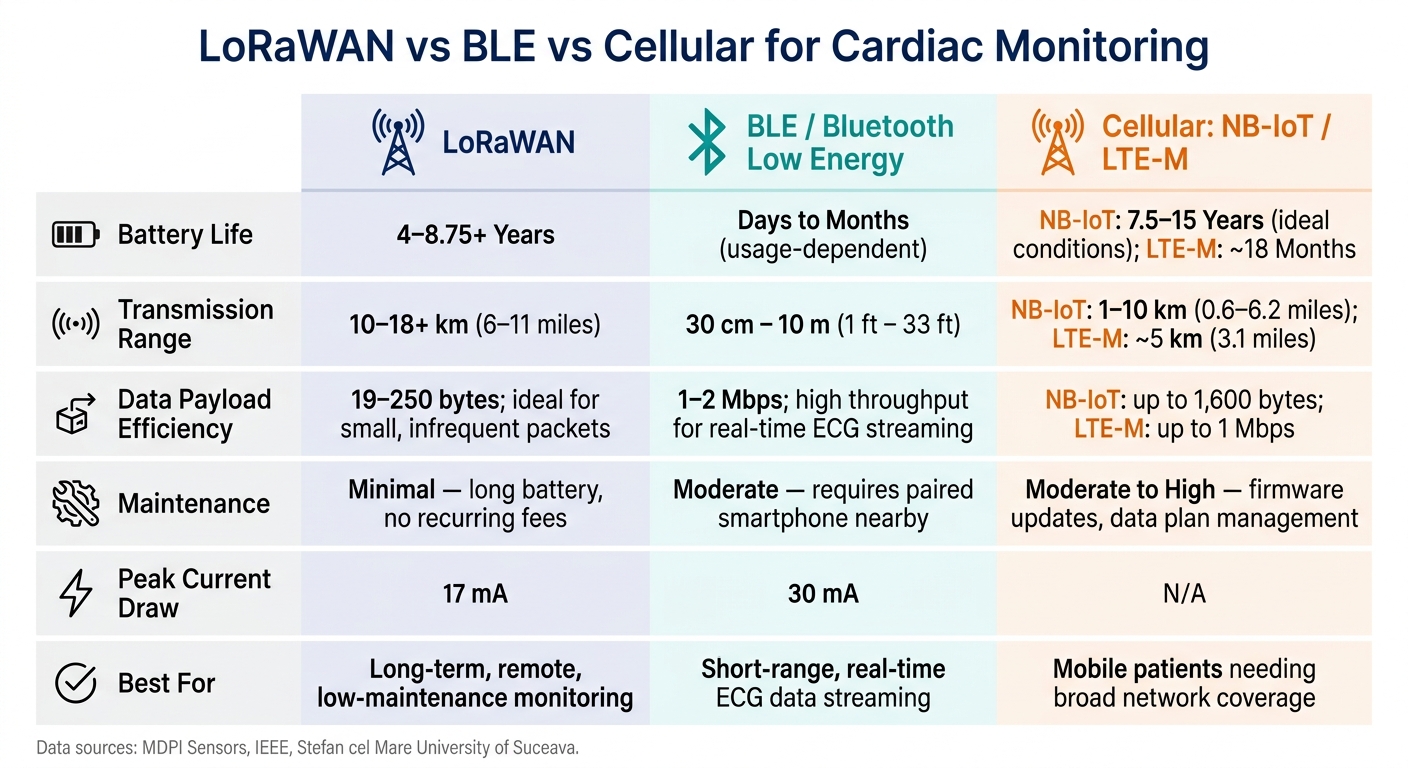
LoRaWAN vs BLE vs Cellular for Cardiac Monitoring: Key Metrics Compared
Each technology comes with its own strengths and weaknesses. Drawing from the detailed breakdowns of LoRaWAN, BLE, and Cellular technologies, this comparison highlights how these systems stack up across key factors for long-term cardiac monitoring. The focus here is on balancing sensor longevity and data efficiency with the practical needs of patient care:
| Factor | LoRaWAN | BLE | Cellular (NB-IoT / LTE-M) |
|---|---|---|---|
| Battery Life | 4–8.75+ years | Varies based on usage | NB-IoT: 7.5–15 years; LTE-M: ~18 months |
| Range | 10–18+ km (approx. 6–11 miles) | ~30 cm to 10 m (approx. 1 ft to 33 ft) | NB-IoT: 1–10 km (approx. 0.6–6.2 miles); LTE-M: ~5 km (approx. 3.1 miles) |
| Payload Efficiency | Ideal for small, infrequent packets (19–250 bytes) | High throughput over short distances | NB-IoT supports up to 1,600 bytes; LTE-M up to 1 Mbps |
| Maintenance | Minimal; long battery life and no recurring fees | Moderate; requires a paired smartphone | Moderate to high; needs firmware updates and data plan management |
LoRaWAN stands out for its power efficiency, with a peak current draw of just 17 mA – significantly lower than BLE’s 30 mA. This efficiency directly extends device lifespans, making it a compelling option for applications requiring long-term, unattended monitoring.
BLE, on the other hand, shines in delivering high data throughput (1–2 Mbps), which is perfect for transmitting detailed ECG data bursts. However, its reliance on a nearby smartphone or tablet can pose challenges, especially for elderly patients or those in areas with limited access to compatible devices. Cellular telemetry sidesteps this issue by connecting directly to carrier networks, eliminating the need for additional hardware. However, LTE-M’s higher power consumption limits battery life to about 18 months, which can lead to increased costs and interruptions in clinical use.
This comparison underscores the trade-offs inherent in each technology. LoRaWAN and NB-IoT are ideal for extended battery life, BLE excels in short-range, high-data scenarios, and cellular options provide reliable connectivity without external devices. The best choice ultimately depends on whether the priority is long-term, maintenance-free operation, detailed real-time data, or simple infrastructure requirements.
Conclusion
LoRaWAN stands out as a practical solution for long-range, low-maintenance cardiac monitoring. Its ability to transmit vital health data over extended distances, combined with a battery life that lasts for years, makes it especially useful in rural areas, sprawling hospital campuses, or even smart city health networks – places where frequent battery changes or managing extensive infrastructure can be a challenge.
For scenarios requiring continuous, high-resolution ECG streaming, technologies like Bluetooth Low Energy (BLE), with data rates up to 1 Mbps, offer better throughput. Cellular options like LTE-M are another solid choice, providing reliable coverage for patients on the move. These options highlight how the best technology depends on the specific needs of the monitoring application.
When it comes to long-term cardiac monitoring, the key is finding the right balance between energy efficiency and the application’s requirements. LoRaWAN excels in routine, non-critical tracking of metrics like heart rate and blood oxygen levels. Its low energy consumption and minimal infrastructure demands make it a cost-effective, scalable option. For healthcare providers using LoRaWAN, enabling Adaptive Data Rate (ADR) can further optimize transmission settings based on the patient’s condition and distance from the gateway, enhancing battery life while maintaining dependable performance.
FAQs
What cardiac data works best with LoRaWAN?
LoRaWAN is well-suited for transmitting critical cardiac data such as electrocardiogram (ECG) signals, heart rate, and oxygen saturation (SpO2) levels. Its low-power and long-range capabilities make it an excellent choice for continuous, energy-efficient monitoring of these metrics. For situations requiring high-priority or large data transfers, LoRaWAN can work alongside other protocols like 5G to ensure seamless communication. Companies like CHOOVIO provide LoRaWAN sensors and gateways, offering dependable tools for remote healthcare monitoring.
How often can a LoRaWAN monitor transmit and still last years?
A LoRaWAN monitor equipped with a 2400 mAh battery can operate for approximately one year if it sends a message every five minutes. However, cutting down the frequency of transmissions can greatly increase the battery’s lifespan, with a theoretical upper limit of up to six years for very infrequent messaging. CHOOVIO offers IoT sensors and gateways designed specifically for these low-power, energy-efficient networks.
What can reduce LoRaWAN battery life in real deployments?
Frequent transmissions with short intervals can significantly reduce LoRaWAN battery life. Similarly, higher energy consumption occurs when acknowledgments or retransmissions are required. Settings like larger spreading factors or specific bandwidth choices can also increase airtime, further draining the battery. Additionally, radio impairments, such as bit errors, contribute to more retransmissions and collisions, which negatively affect energy efficiency.

