

How Multi-Gateway Deduplication Works
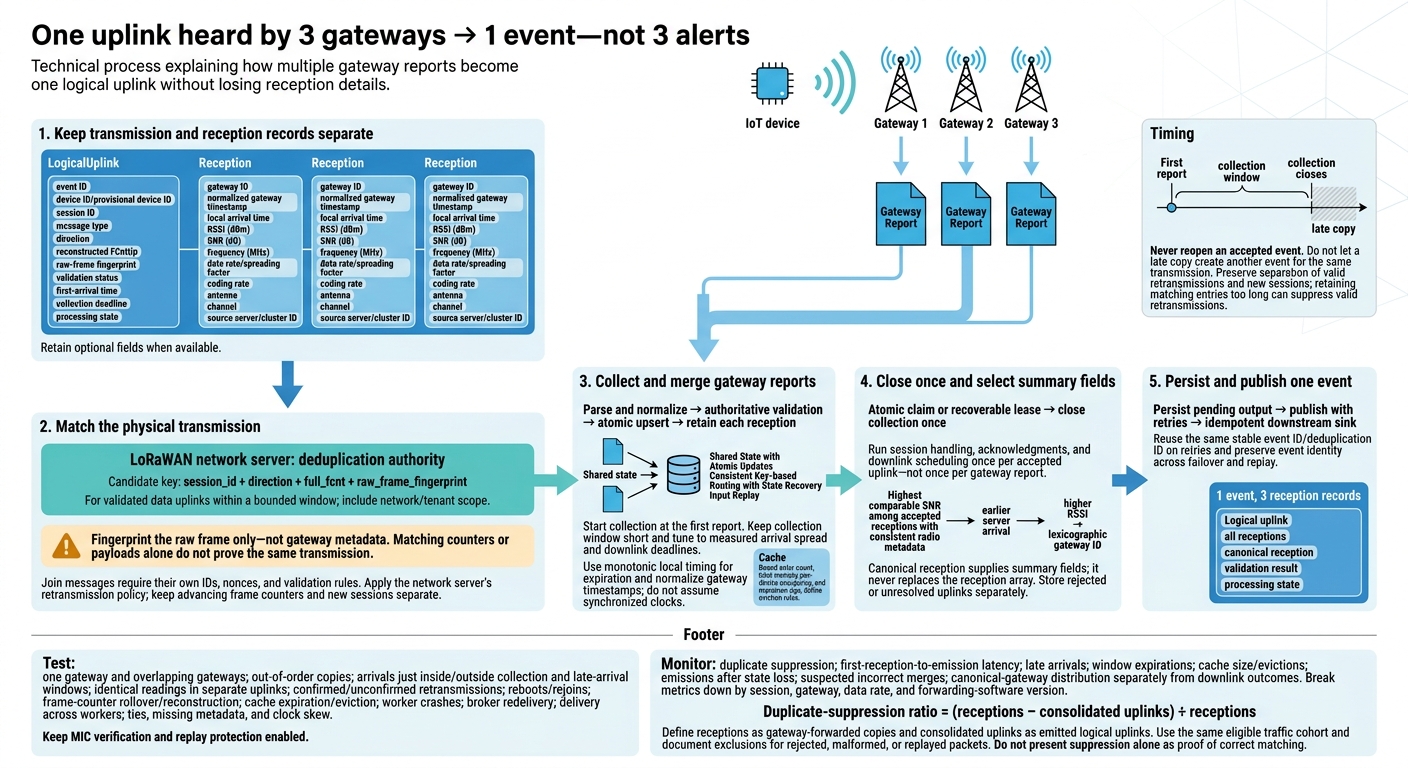
One uplink heard by 3 gateways should produce 1 event – not 3 alerts. I start deduplication at the LoRaWAN network server, where session details, frame counters, and timing help match gateway copies without merging separate transmissions.
Here’s what I focus on:
- Match the transmission: Use session context, frame counters, and a raw-frame fingerprint – not payload equality.
- Keep every reception: Retain gateway IDs, signal readings, and timestamps. Choose one reception only for summary fields.
- Set timing limits: Use a short collection window and handle late copies without reopening accepted events.
- Prevent repeat delivery: Share state across workers and reuse a stable event ID during retries.
- Test failure cases: Check retransmissions, session changes, delays, and crashes while keeping validation enabled.
<u>The goal is one event with all its reception details intact.</u> I track suppression, latency, and cache health to check that duplicate removal isn’t hiding separate uplinks.
How Multi-Gateway LoRaWAN Deduplication Works
Step 1: Define Records, Matching Keys, and Timing
Keep Session and Reception Details
Create a parent LogicalUplink record containing the event ID, device ID or provisional device ID, session ID, message type, direction, reconstructed FCntUp, raw-frame fingerprint, validation status, first-arrival time, collection deadline, and processing state.
Attach one Reception record for each gateway report. Include the gateway ID, normalized gateway timestamp, local arrival time, RSSI, SNR, frequency, data rate or spreading factor, coding rate, antenna, channel, and source server/cluster ID. Record RSSI in dBm, SNR in dB, and frequency in MHz. Retain optional fields when available.
Keep reception records separate so merging doesn’t erase evidence.
Distinguish Gateway Copies From Retransmissions
For validated data uplinks within a bounded window, use session_id + direction + full_fcnt + raw_frame_fingerprint as the candidate key for one physical transmission. Fingerprint only the raw frame – not gateway metadata. Handle join messages separately, using their own IDs, nonces, and validation rules.
Matching counters or payloads don’t prove that reports came from the same transmission. Retransmissions and new sessions can reuse both. Apply the network server’s own rules to retransmissions. Keep later uplinks separate when the frame counter advances, even if the payload stays the same.
Set Collection and Late-Copy Windows
Start collection when the first report arrives. Keep the collection window short, and tune it to measured arrival spread and downlink deadlines. Use monotonic local timing for expiration. Normalize gateway timestamps instead of assuming gateway clocks are synchronized.
Set cache limits for entry count, total memory, per-device occupancy, and maximum age, with clear eviction rules. Drop late copies after the window closes; retaining entries too long can suppress valid retransmissions.
sbb-itb-0e600ab
Step 2: Merge Receptions Into One Uplink
Parse, Match, Merge, and Emit Records
Use the transmission-aware key to merge matching reports into one logical uplink. An atomic upsert lets concurrent gateway reports join the same collection. Run session handling, acknowledgments, and downlink scheduling once per accepted uplink – not once per report.
on_report(input): r = parse_and_normalize(input) key = candidate_key(r) # Include network/tenant scope validation = authoritative_validation(r) atomically: c = get_or_create_collection(key) if c.closed: classify_late(r, c, retention_rules, transmission_evidence) return c.store_reception(r, validation) if validation.accepted and preferred_by_policy(r, c.canonical): c.update_canonical(r, reason) on_collection_deadline(collection_id): atomically: c = claim_and_close_once(collection_id) if c: pending_output.save(build_event(c, deduplication_id=c.output_id)) publish_pending_output_with_retries(): idempotent_sink.put(event.output_id, event) When the collection closes, emit one event containing the logical uplink, reception array, canonical reception, validation result, and processing state. Store rejected or unresolved uplinks separately. Send late copies to retained observations or a correction stream; do not reopen accepted events.
Choose a Canonical Reception
The canonical reception supplies summary fields. It does not replace the reception array. Pick an explicit policy and apply it consistently.
For a highest SNR policy, select the accepted reception with the highest comparable SNR and consistent radio metadata. Break ties by earlier server arrival, then higher RSSI, then gateway ID in lexicographic order.
Share Deduplication State Across Servers
When reports reach different workers, those workers need shared deduplication state before they can merge reports.
Use shared state with atomic updates, or route reports consistently by key to one owner. Assign collection closure through a lease or atomic claim that allows recovery after ownership expires. Key-based routing still requires state recovery or input replay if a worker fails.
Persist pending output before publishing it, and reuse its deduplication ID on retries. This prevents an emission failure from causing a second downstream effect.
Step 3: Test and Monitor Deduplication
Once you’ve defined the merge logic, test the full gateway-to-server path under live forwarding conditions. Check packet format, gateway IDs, timestamps, RSSI, SNR, and validation status. Verify the exact packet-forwarder format, timestamps, metadata, and network-server integration used in deployment. Hardware alone doesn’t determine deduplication behavior.
Test Delays, Retransmissions, and Session Changes
Use the same event IDs, candidate keys, collection windows, and canonical-reception rules defined earlier.
Run repeatable tests with one gateway, overlapping gateways, and out-of-order copies. Test arrivals just inside and outside both the collection and late-arrival windows. Include identical readings sent in separate uplinks, confirmed and unconfirmed retransmissions, reboots, and rejoins. Test frame-counter rollover and reconstruction boundaries, too.
Force cache expiration, eviction, worker crashes, broker redelivery, and delivery across workers. Check event counts, retained receptions, latency, and final session state. Keep MIC verification and replay protection enabled throughout testing.
Track Duplicate Suppression, Latency, and Cache Health
Check whether the merge logic emits one logical uplink per physical transmission. Define receptions as gateway-forwarded copies and consolidated uplinks as emitted logical uplinks. For the same eligible traffic cohort, calculate:
Duplicate-suppression ratio = (receptions − consolidated uplinks) ÷ receptions
Document whether the calculation excludes rejected, malformed, or replayed packets. Otherwise, the ratio could hide unrelated behavior.
Measure latency from first reception to emission, and track late arrivals separately. Monitor deduplication-window expirations, cache evictions, cache size, and records emitted after state loss. Keep suspected incorrect merges separate from retransmission handling, and investigate any merge across session boundaries.
Track canonical-gateway distribution separately from downlink outcomes. Test selection ties, missing metadata, and clock skew. Retain device and session identifiers, reconstructed counters, gateway IDs, reception and ingestion times, RSSI, SNR, validation results, and processing status.
Break down metrics by session, gateway, data rate, and forwarding-software version. This helps locate failures without treating normal overlapping coverage as an error.
Conclusion: Emit One Event and Keep Reception Details
Make the network server the deduplication authority. Merge gateway copies using session context, frame counter, and transmission timing. Then emit one stable event_id for idempotent downstream delivery.
After emission, store the payload, device/session identity, frame counter, and all_receptions for debugging and coverage analysis. Use canonical selection only for summary fields.
Before deployment, check these rules:
- Retransmissions: Follow the configured retransmission policy to separate gateway copies from true retransmissions and prevent duplicate application data.
- Timing: Close the collection window on time. Late copies must not create a new event, and downlink timing must stay tied to the original uplink.
- Sessions and recovery: Keep reused frame counters in new sessions separate. Preserve event identity across failover, replay, and delivery retries.
FAQs
How do I choose a deduplication window?
Set the deduplication window slightly longer than the maximum expected delay between the first and last gateway receiving the same packet. This gives the network server time to collect duplicates from all gateways that heard the transmission.
Too short, and the window may miss duplicates. Too long, and it adds unnecessary latency to application data processing.
How can I detect incorrectly merged uplinks?
Watch network server logs for unexpected frame counter (Fcnt) jumps or duplicate counts. These can point to mishandled packets or incorrectly merged uplinks. Also check for Message Integrity Code (MIC) mismatches, which may signal corrupted or incorrectly reconstructed frames.
Cross-check the logs against gateway IDs and timestamps to confirm that the server filters out redundant transmissions without merging separate events.
How do I preserve deduplication state during failover?
Configure end devices to store Device Address, session keys, and frame counters in non-volatile memory. This lets devices resume operation after power cycles or network interruptions without rejoining the network.
For network-level resilience, choose gateways with multiple backhaul options and automatic failover to keep them connected to the network server.

