

LoRaWAN Compliance: Avoiding Harmful Interference
LoRaWAN devices operating in the U.S. must meet strict compliance rules to avoid harmful interference and ensure reliable network performance. Here’s what you need to know:
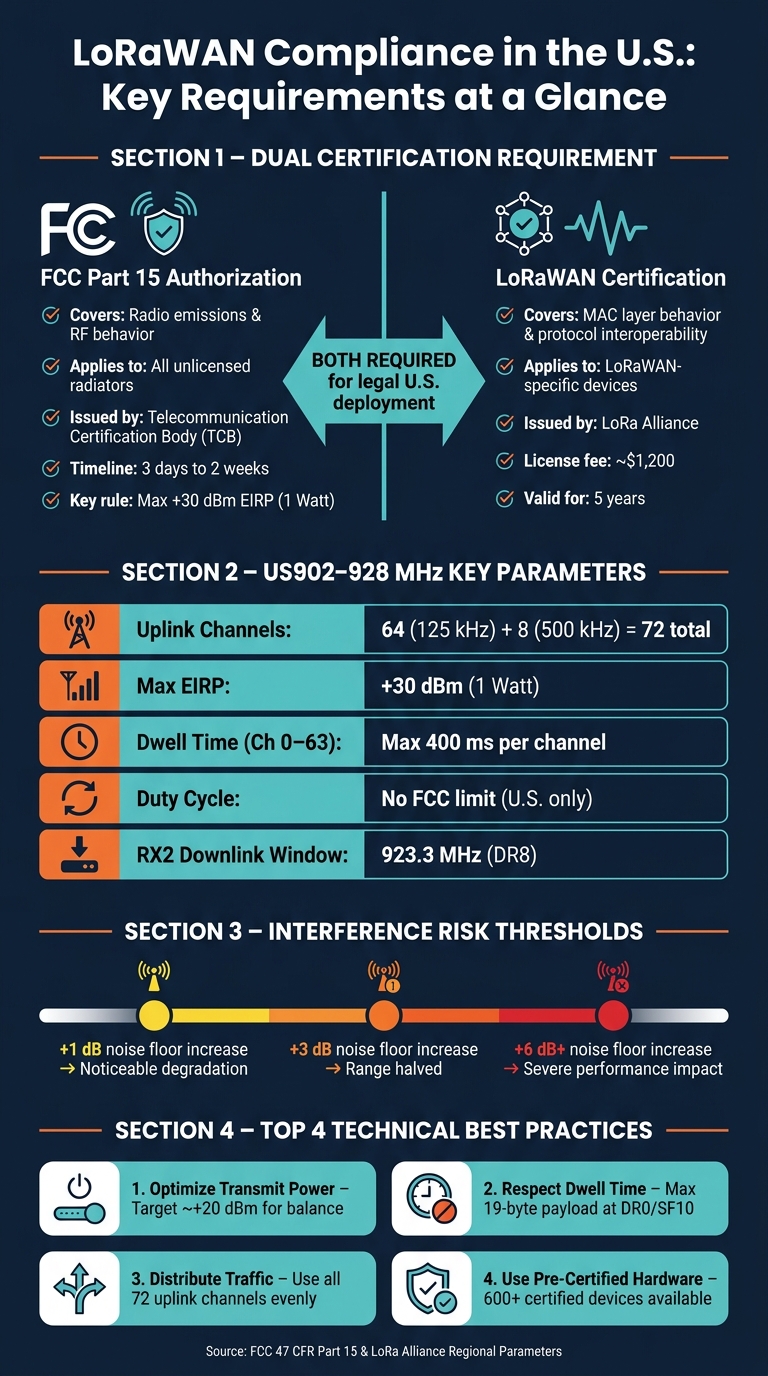
- FCC Part 15 Compliance: Mandatory for all devices operating in the 902–928 MHz ISM band. Key rules include power limits (max +30 dBm EIRP), dwell time restrictions (400 ms per channel), and emission standards.
- LoRaWAN Certification: Focuses on protocol adherence and interoperability but does not replace FCC approval. This certification ensures proper frequency hopping, MAC behavior, and network compatibility.
- Harmful Interference: Non-compliant devices can raise the noise floor, disrupting communication for other users in the shared spectrum.
- Technical Best Practices: Optimize transmit power, manage dwell time, and distribute traffic evenly across available channels to reduce interference.
To legally operate and maintain network efficiency, ensure your devices are FCC-certified and follow LoRaWAN protocol guidelines. Use pre-certified hardware to simplify deployment and focus on proper network design, including gateway placement and capacity planning.
LoRaWAN US902–928 MHz Compliance: FCC vs LoRa Alliance Certification
Key Regulatory Requirements for LoRaWAN in the U.S.
FCC Rules for ISM Band Use
LoRaWAN devices in the U.S. must comply with 47 CFR Part 15, which sets the rules for unlicensed radio frequency devices. Under Subpart C, LoRaWAN end-nodes and gateways are categorized as intentional radiators, meaning they must meet specific standards.
Before being sold or deployed, these devices need certification from a Telecommunication Certification Body (TCB). The FCC differentiates between master devices (like gateways, which control channel selection and network initiation) and client devices (end-nodes operating under the gateway’s direction). This distinction influences testing and authorization protocols.
Devices operating in the 902–928 MHz band must adhere to strict emission limits:
- Fundamental emissions: Maximum field strength of 500 millivolts per meter at 3 meters.
- Harmonic emissions: Capped at 1.6 millivolts per meter.
Additionally, the FCC restricts antenna modifications. Devices with fixed or proprietary antennas cannot use higher-gain replacements without voiding certification. To prevent unauthorized amplification, devices meant for non-professional setups cannot include standard antenna jacks.
These rules form the foundation for the specific regional parameters outlined next.
LoRaWAN Regional Parameters for US902–928
The US902–928 MHz frequency plan aligns with FCC requirements, offering two compliance paths: Frequency Hopping Spread Spectrum (FHSS) and Digital Modulation. For narrowband signals (under 250 kHz), the FCC mandates at least 50 hopping channels to allow a maximum output of 1 Watt. LoRaWAN exceeds this with 72 uplink channels: 64 at 125 kHz and 8 at 500 kHz. The wider 500 kHz channels meet the Digital Modulation requirement for a minimum 6 dB bandwidth of 500 kHz.
"The dwell time for LoRaWAN in the US902-928 band refers to the amount of time that a device spends on a specific channel before switching to the next channel… it helps to ensure that devices are able to successfully transmit data while avoiding interference." – The Things Network
Here’s a breakdown of key parameters:
| Parameter | US902–928 Value | FCC Compliance Purpose |
|---|---|---|
| Uplink Channels | 64 (125 kHz) + 8 (500 kHz) | Exceeds FHSS >50 channel requirement |
| Max EIRP | +30 dBm (1 Watt) | Maximum allowed for unlicensed radiators |
| Dwell Time (Ch 0–63) | Max 400 ms | Meets FCC 0.4 s occupancy limit |
| Duty Cycle | No limit | FCC Part 15 does not mandate duty cycles |
| RX2 Window | 923.3 MHz (DR8) | Fixed downlink for simplified gateway communication |
Lower data rates require higher spreading factors, which increase time-on-air. For example, at SF12, a single packet can approach or even exceed the 400 ms dwell time limit. This makes the choice of payload size and data rate critical for both regulatory compliance and network efficiency.
How LoRaWAN Certification Supports Compliance
While FCC certification focuses on radio emissions, LoRaWAN certification – provided by the LoRa Alliance – ensures proper MAC layer behavior, which FCC testing does not address. This certification verifies that devices implement features like frequency hopping, join procedures, and responses to network server commands correctly. By doing so, it reduces interference risks.
The LoRaWAN Certification Test Tool (LCTT) evaluates whether a device adheres to the US902–928 frequency plan, stays within power limits, and handles MAC commands like:
LinkADRReq: Adjusts data rate and transmit power remotely.DutyCycleReq: Manages duty cycle settings.
"LoRaWAN certification… covers the behaviour of the LoRaWAN MAC layer, compliance with regional parameters, and interoperability with network servers, but it does not address… national spectrum requirements." – Hugues Orgitello
For U.S. operations, devices must support data rates DR0–DR4 and DR8–DR13 to achieve certification. Using pre-certified modules, such as the Murata Type ABZ or STM32WL, can simplify the LCTT process for final products. Both the LoRaWAN Certified certificate and the FCC test report are essential for legally compliant, interference-free deployment.
sbb-itb-0e600ab
LoRa/LoRaWAN tutorial 3: Rules and Regulations
Technical Methods to Prevent Harmful Interference
These technical strategies build upon regulatory and certification requirements to ensure LoRaWAN deployments operate without interference.
Controlling Transmit Power and EIRP
Once regulatory limits are understood, fine-tuning transmit power ensures devices stay within allowable boundaries. Effective Isotropic Radiated Power (EIRP) represents the total radiated power in a specific direction, calculated as transmitter power plus antenna gain minus cable loss. For U.S. deployments, the FCC caps EIRP at +30 dBm. Operating at around +20 dBm often strikes a good balance – offering reliable connectivity while reducing interference by lowering the noise floor. If you change antennas or extend cable runs, always recalculate EIRP to remain compliant with FCC standards.
Managing Dwell Time and Duty Cycles
Unlike Europe, where duty cycle restrictions are strict, LoRaWAN networks in the U.S. under FCC Part 15 face no duty cycle limits. Instead, a 400 ms dwell time applies to 125 kHz uplink channels. Dwell time refers to how long a device stays on a single frequency before switching to another. For devices operating at DR0 (SF10/125 kHz), keep the MAC payload limited to 19 bytes to stay within the 400 ms dwell time. For larger payloads, use 500 kHz channels (64–71, DR4), which are exempt from this restriction. Switching channels after each transmission also helps avoid congestion, ensuring smoother network performance.
Channel and Frequency Planning
After managing transmit power and dwell times, effective channel planning becomes key to reducing interference. Distributing traffic evenly across available channels prevents signal collisions, especially in dense networks. The table below outlines the primary channel parameters for U.S. LoRaWAN deployments, highlighting how balanced channel use supports interference-free communication:
| Direction | Channels | Frequency Range | Bandwidth | Data Rates |
|---|---|---|---|---|
| Uplink | 64 | 902.3–914.9 MHz | 125 kHz | DR0–DR3 |
| Uplink | 8 | 903.0–914.2 MHz | 500 kHz | DR4 |
| Downlink | 8 | 923.3–927.5 MHz | 500 kHz | DR8–DR13 |
Using all 72 uplink channels reduces the chance of simultaneous transmissions colliding. During the join process, devices should randomly select channels from the entire pool to avoid overloading specific frequencies. Additionally, automated channel management tools integrated into network servers and gateways simplify frequency coordination, making it easier to scale deployments in settings like industrial operations or smart cities.
"The US902–928 MHz band is a powerful foundation for massive IoT in North America – but only if properly managed. With ThingPark, we’ve built automation into every layer, so operators can scale quickly, securely, and in full compliance with FCC rules." – Ramez Soss, Actility
Practical Guidelines for LoRaWAN Network Design
Designing a LoRaWAN network requires careful attention to practical details to ensure smooth operation and minimal interference.
Gateway Placement Best Practices
The placement of gateways plays a huge role in the success of any LoRaWAN deployment. Elevating a gateway by just 33 feet (10 meters) can boost coverage by 20–40%. Ideal spots for installation include rooftops, water towers, and communication masts. These locations help maintain a clear Fresnel zone – the elliptical area radio waves travel through between transmitter and receiver. Any obstruction in this zone can lead to signal loss.
To minimize signal loss from long coaxial cable runs, keep cables under 10 feet (3 meters). Use high-quality cables like LMR-400 or better, and consider Power over Ethernet (PoE) to mount the gateway closer to the antenna.
Selecting the right antenna is equally important. A 3 dBi antenna provides an omnidirectional signal pattern, making it suitable for hilly or indoor environments. On the other hand, a 5–8 dBi antenna offers a flatter, wider coverage area, ideal for flat, open terrain. When installing on rooftops shared with cellular equipment, ensure vertical separation by placing the LoRaWAN antenna either above or below cellular antennas. In urban areas near LTE towers or broadcast transmitters, using an industrial-grade cavity filter can help block out unwanted signals before they disrupt the gateway.
"A $500 LoRaWAN gateway mounted on a high tower will outperform a $2,000 unit hidden in a basement." – Robert Liao, Technical Support Engineer, Robustel
Once the physical setup is optimized, attention shifts to managing network capacity for dense deployments.
Capacity Planning for Dense Deployments
Managing network capacity is essential to avoid channel congestion and interference. A single gateway can typically support between 500 and 2,000 nodes, depending on factors like Spreading Factor (SF) distribution and transmission frequency. Devices using higher spreading factors (SF10–SF12) consume significantly more airtime than those using SF7. For instance, SF12 can take up 8–32 times more airtime than SF7. This means a few distant devices with high SF settings can monopolize airtime, limiting capacity for others.
Adaptive Data Rate (ADR) helps address this by encouraging devices to use lower spreading factors when signal conditions permit. However, it’s important to test ADR during pilot phases, especially in challenging environments like underground areas or metal-heavy industrial sites, to ensure it works effectively before scaling up.
Research from Ghent University highlights the challenges of heavy network loads. When 1,000 nodes transmit at the maximum 1% duty cycle, packet loss rates at a single gateway can reach up to 32%. To maintain performance, deploy multiple gateways and keep transmission rates below regulatory limits.
Downlink traffic also impacts capacity. Each confirmed uplink message triggers a downlink acknowledgment, temporarily preventing the gateway from receiving other transmissions. To mitigate this, reduce the use of confirmed messages and batch configuration updates at the application level instead of sending them individually.
Even with these optimizations, monitoring and addressing interference is key to long-term network reliability.
Detecting and Resolving Interference Issues
Interference can disrupt even the best-planned networks. A rising noise floor is a common indicator – just a 1 dB increase is noticeable, while 3 dB halves the range, and anything over 6 dB can severely impact performance. Real-time monitoring of SNR (Signal-to-Noise Ratio) and RSSI (Received Signal Strength Indicator) across gateways can provide early warnings before packet delivery rates are affected.
Before deploying a gateway, use a LoRaWAN field tester to assess signal strength and quality at the site. This helps identify dead zones and interference-prone areas before installation. For live networks, RF spectrum analysis tools can be invaluable. These tools model harmonics and intermodulation across multiple wireless bands – including 5G NR FR1, LTE, and LoRaWAN – helping engineers pinpoint external interference sources.
If filtering isn’t feasible because the interference comes from the same unlicensed band, increasing the physical distance between the gateway and the interference source is often the best solution. For critical deployments, plan for 20–30% coverage overlap between adjacent gateways. This overlap allows end-nodes to connect to multiple gateways, improving packet reception even in high-density environments.
Testing and Documentation for Ongoing Compliance
Pre-Deployment Compliance Testing
Before rolling out your network, it’s critical to confirm that your devices meet FCC requirements. Most LoRaWAN devices operating in the 902–928 MHz band must comply with FCC Part 15.247, which enforces specific limits: a maximum conducted output power of 1 watt (30 dBm), a minimum 6 dB bandwidth of at least 500 kHz for digitally modulated signals, and a power spectral density limit of 8 dBm in any 3 kHz band.
Start by testing devices with the LoRaWAN Certification Test Tool (LCTT) to identify and resolve any MAC layer issues. Once internal testing is successful, send the device to an FCC-recognized Authorized Test Lab (ATL) for official RF verification. The certification process typically takes 3 days to 2 weeks, with the LoRa Alliance license fee averaging $1,200.
"Proper RF performance testing prevents costly field failures and ensures devices operate as intended, minimizing interference with other wireless systems and meeting crucial regulatory compliance standards." – LoRa Alliance
For your Telecommunication Certification Body (TCB) documentation, include schematics, block diagrams, photos, test reports, an FCC ID label, and a user manual with the necessary regulatory statements.
Maintaining Compliance After Deployment
Compliance doesn’t end with deployment – it’s an ongoing commitment. A LoRa Alliance Certificate of Compliance remains valid for 5 years, provided there are no significant changes to the device’s functionality or operation. Any updates to the LoRaWAN stack – like custom MAC commands or timing adjustments – can invalidate the original certification, requiring new testing and updated documentation.
Firmware updates are a common compliance challenge. Before releasing any over-the-air update, assess whether the changes affect RF behavior or regional parameters. If they do, you may need to update your documentation or pursue re-certification. Regular compliance reviews can help avoid issues caused by firmware changes. For minor product variations – such as a new enclosure or sensor module using the same transceiver and protocol version – Certification by Similarity (CbS) allows you to certify up to three additional devices for $750, without requiring full re-testing. Additionally, maintain records of test results and facilities as mandated by FCC Section 2.938.
To simplify long-term compliance, consider starting with hardware that’s already certified.
Using Certified Devices and Trusted Suppliers
Sourcing pre-certified hardware can significantly streamline compliance efforts. With over 600 LoRaWAN certified devices currently available, you can choose from a wide range of options that have already been rigorously tested for RF behavior, frequency hopping, and regional parameters. This reduces the risk of integration issues and ensures a smoother deployment process.
"Certification ensures that devices conform to a specific set of standards and protocols, promoting interoperability between different manufacturers’ devices." – LoRa Alliance
For example, CHOOVIO offers a comprehensive selection of certified LoRaWAN sensors and gateways tailored for the US market. Their products, including devices for temperature, humidity, CO2, and motion detection, are designed to meet US902–928 regional parameters right out of the box. By working with trusted suppliers like CHOOVIO, you can reduce compliance headaches and focus on building a reliable, long-term network.
Conclusion
Ensuring compliance is the cornerstone of maintaining reliable network performance in LoRaWAN systems. The 902–928 MHz spectrum is a shared resource, and when devices exceed transmit power limits, neglect dwell time restrictions, or fail to implement proper frequency hopping, interference can quickly escalate, disrupting the entire band.
To operate legally and ensure seamless MAC interoperability, devices must meet FCC Part 15 authorization and obtain LoRaWAN Certification. Confusing these two certifications or neglecting either can lead to costly mistakes. Together, these certifications help safeguard the integrity of IoT networks by enforcing critical requirements like transmit power limits, dwell time adherence, and frequency-hopping spread spectrum (FHSS) compliance – factors essential for large-scale IoT deployments.
The smartest approach is to prioritize compliance from the very beginning. This means using pre-certified hardware, employing Adaptive Data Rate (ADR) for efficiency, keeping detailed documentation, and planning for firmware updates that might affect RF behavior. Networks built with compliance in mind are easier to scale, troubleshoot, and maintain in the long run.
For a hassle-free start, consider using pre-certified LoRaWAN devices from CHOOVIO. Their products simplify regulatory compliance and make network deployment more efficient.
FAQs
Do I need both FCC approval and LoRaWAN certification?
Yes, both are typically needed for a device to meet requirements in the United States. FCC approval ensures the device complies with spectrum regulations, avoiding harmful interference. Meanwhile, LoRaWAN certification verifies that the device operates correctly at the MAC layer and can seamlessly interact with other devices in LoRaWAN networks. While FCC compliance is a legal mandate, LoRaWAN certification is often essential for integrating devices into commercial IoT ecosystems.
How can I stay under the 400 ms dwell-time limit with my payloads?
To stay within the 400 ms dwell-time limit for the US902-928 MHz band, it’s crucial to manage your transmission duration wisely. Start by using an airtime calculator to estimate how long your message will take to send, factoring in payload size and data rate. To shorten airtime, enable Adaptive Data Rate (ADR) to achieve higher data rates, and adjust your transmission intervals to reduce the frequency of messages. Another effective strategy is to spread traffic across multiple channels or sub-bands, which helps balance the channel load efficiently.
What are the fastest ways to find interference in a live LoRaWAN network?
The fastest way to spot interference in a live LoRaWAN network is to perform site surveys. These surveys help you analyze radio frequency activity and pinpoint sources of noise. Be on the lookout for potential disruptors like LTE base stations or ISM-band devices such as Wi-Fi routers and microwaves. Pay attention to the signal-to-noise ratio, as it can reveal interference issues. Additionally, use specialized tools to evaluate link quality and identify environmental barriers. This approach makes it easier to troubleshoot localized signal problems.

