

CO2 Monitoring: Top 8 IoT Sensors Compared
Monitoring CO2 levels is essential for ensuring better indoor air quality, which affects health, productivity, and energy use in buildings. This article breaks down eight LoRaWAN CO2 sensors, highlighting their features, accuracy, battery life, and integration capabilities. As a result, these sensors help manage HVAC systems efficiently, especially in smart buildings. Here’s a quick look:
- QingPing LoRaWAN CO2 Sensor: Affordable and reliable with customizable reporting intervals.
- EvolvePlus Indoor Air Quality Series: Multiple models with varying accuracy levels for different needs.
- MClimate CO2 Sensor & Notifier: Long battery life and built-in notifications for air quality alerts.
- Talkpool OY1210: Rugged design for extreme conditions with precise readings.
- CHOOVIO LoRaWAN Solutions: Multiple sensors tailored for various applications, offering flexibility.
- Senseair Sunrise: Compact and energy-efficient for precision-focused tasks.
- Elsys ERS CO2 Sensor: Multi-parameter monitoring with long battery life and robust design.
- Decentlab DL-LP8P: High-end, weatherproof sensor with detailed environmental data.
Quick Comparison
| Sensor | Accuracy | Battery Life | Best Use Case | Price Range |
|---|---|---|---|---|
| QingPing LoRaWAN CO2 | ±50 ppm | Long-lasting | Small offices, residential spaces | Under $200 |
| EvolvePlus Series | ±30 ppm (Pro models) | Moderate | Smart buildings, offices | Varies |
| MClimate CO2 Notifier | ±50 ppm | Up to 10 years | Classrooms, meeting rooms | $255 |
| Talkpool OY1210 | ±30 ppm ±3% of reading | Extended | Industrial sites | $450+ |
| CHOOVIO Solutions | ±30-50 ppm | Varies | Quick deployments | Varies |
| Senseair Sunrise | ±30 ppm | 2-8 years | Labs, precision tasks | Expensive |
| Elsys ERS CO2 | ±50 ppm or ±5% | Up to 10 years | Research, environmental tracking | Moderate |
| Decentlab DL-LP8P | ±50 ppm or ±3% | Long-lasting | Outdoor, critical infrastructure | $795 |
Choose a sensor based on your specific needs, such as accuracy, reporting frequency, and environmental conditions. Overall, each option offers distinct features tailored to different applications, from small-scale setups to industrial-grade use cases.
MClimate’s Air Quality & CO₂ Monitoring Solutions Comparison and Applications
1. QingPing LoRaWAN CO2 Monitoring Sensor

To start, the QingPing LoRaWAN CO2 sensor stands out as a dependable choice for building managers aiming to monitor indoor air quality efficiently. Known for its reliability in long-term commercial and industrial settings, it uses NDIR technology to deliver accurate CO2 measurements.
Measurement Accuracy
This sensor supports typical indoor ranges of CO2, temperature, and humidity, ensuring consistent and precise readings over time.
Battery Life
The sensor uses an extended battery design, minimizing the need for frequent maintenance, making it ideal for larger installations where accessibility might be a challenge.
Reporting Interval
Users can customize the reporting intervals to balance detailed data collection with prolonged battery life. Adjustments are easily managed through LoRaWAN commands.
Integration and Compatibility
The sensor integrates smoothly with modern network infrastructures and works effortlessly with major LoRaWAN networks. Its straightforward data format allows for seamless incorporation into building management systems and cloud-based IoT platforms, ensuring consistent and reliable communication across various setups.
Additional Features
The sensor’s durable design withstands semi-outdoor conditions and simplifies installation, monitoring, and maintenance. It adheres to modern IoT standards, making it a practical solution for long-term CO2 monitoring in smart building management systems.
2. EvolvePlus Indoor Air Quality Sensor Series
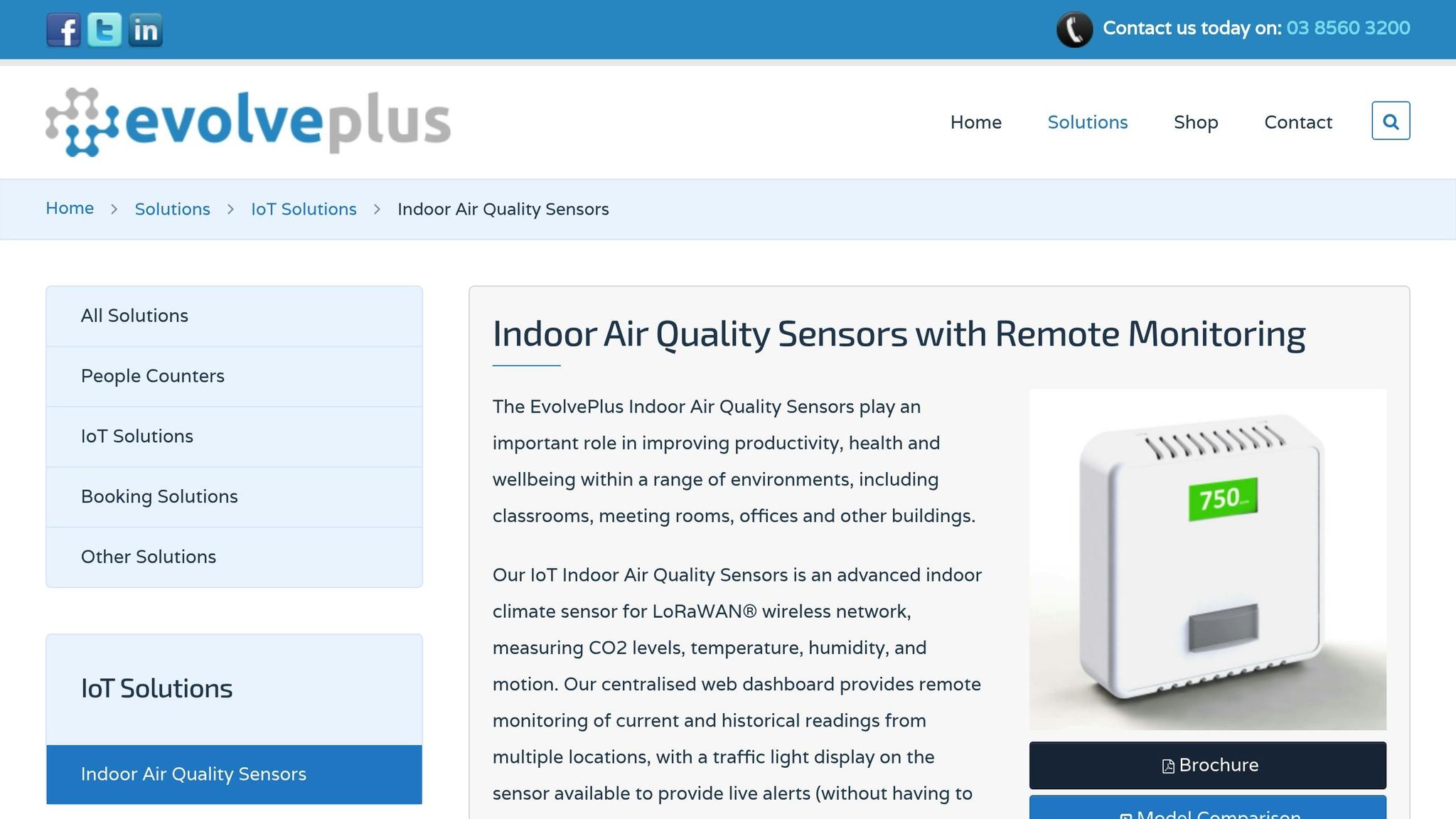
Next, the EvolvePlus series offers a range of CO2 sensors designed to cater to different monitoring requirements. With multiple options available, it ensures accurate monitoring tailored to various applications.
Measurement Accuracy
- Standard and Basic Editions: These models provide a CO2 measurement accuracy of ±50ppm.
- Pro Editions: For situations where greater precision is essential, the Pro models enhance accuracy to ±30ppm.
3. MClimate CO2 Sensor & Notifier LoRaWAN
The MClimate CO2 Sensor & Notifier reliably monitors CO2 and includes built-in notification features, making it a practical choice for maintaining indoor air quality across various settings.
Battery Life
This sensor boasts an impressive battery life of up to 10 years under normal operating conditions . According to MClimate’s LoRaWAN Battery Calculator, it can even exceed 12 years of use at an average consumption rate of 0.4 mAh when paired with Energizer Lithium Ultimate L91 batteries. However, it’s important to note that the device is not compatible with rechargeable batteries. This extended lifespan ensures consistent performance, which is especially critical for large-scale installations.
Integration and Compatibility
In addition to its long-lasting battery, the sensor uses LoRaWAN technology for low-power, long-range data transmission. This allows for seamless integration into existing networks, making it a strong candidate for smart building systems and IoT setups that demand reliable connectivity.
Additional Features
The device includes notification capabilities that alert users when CO2 levels exceed predefined thresholds. At a price of $255.00, it falls within the mid-to-premium price range, offering a balance of functionality and value.
4. Talkpool OY1210 LoRaWAN CO2 Sensor

The Talkpool OY1210 is a versatile sensor designed to measure CO2 levels, temperature, and humidity. It relies on non-dispersive infrared (NDIR) technology for precise CO2 detection, ensuring accurate and reliable monitoring.
Measurement Accuracy
When it comes to CO2 measurements, the OY1210 offers an impressive accuracy of ±30 ppm ±3% of the reading, covering a range from 400 to 5,000 ppm. Its low noise performance further enhances reliability, with CO2 RMS noise levels at 0.7 ppm for 400 ppm and 1.4 ppm for 2,000 ppm when filtered. This consistency makes it a dependable choice for monitoring air quality.
Temperature readings are accurate to ±0.2°C within the range of 0°C to +50°C (32°F to 122°F), while humidity measurements have a precision of ±2% at 10% relative humidity.
Integration and Compatibility
The OY1210 leverages LoRaWAN technology for long-range, low-power data transmission. This makes it particularly suitable for large-scale applications in commercial or industrial settings. Its ability to measure multiple parameters in a single device eliminates the need for separate sensors, simplifying installation and reducing costs. This streamlined approach provides actionable insights for better environmental management.
Additional Features
With its compact design, this sensor delivers detailed environmental data, enabling facility managers to fine-tune HVAC systems and enhance occupant comfort. Its multi-functional capabilities make it a practical solution for improving indoor air quality and operational efficiency.
5. CHOOVIO LoRaWAN CO2 Monitoring Solutions

Notably, CHOOVIO provides a range of five LoRaWAN CO2 sensors tailored for smart building management and environmental monitoring. The lineup includes the Dragino AQS01-L, MClimate CO2 Display, SL311US, SenseCAP S2103, and Milesight EM500-CO2.
Measurement Accuracy
The sensors in CHOOVIO’s lineup offer varying levels of measurement precision. The MClimate CO2 Display and SenseCAP S2103 deliver high accuracy at ±30 ppm +3% of the reading, while the Milesight EM500-CO2 matches this performance with ±30 ppm or ±3% of the reading. For those seeking moderate precision, the SL311US provides ±40 ppm +5%, and the Dragino AQS01-L offers ±50 ppm +3%. This variety allows organizations to choose a sensor that balances accuracy with cost considerations.
Integration and Compatibility
All sensors are designed to integrate smoothly with LoRaWAN networks and support multiple frequency bands, ensuring flexibility in deployment. The SenseCAP S2103 goes a step further by also monitoring temperature and humidity, while the MClimate CO2 Display includes a built-in screen for viewing readings on-site. These features make the sensors adaptable to a variety of monitoring scenarios.
Additional Features
Some options in the lineup include extra functionality to meet specific needs. For instance, the SL311US features a low-power 2.9-inch E-paper display for convenient on-site monitoring. With this diverse portfolio, CHOOVIO offers solutions that cater to both basic and more advanced environmental monitoring requirements.
sbb-itb-0e600ab
6. Senseair Sunrise LoRaWAN CO2 Sensor

The Senseair Sunrise is a compact CO2 sensor module tailored for battery-powered, wireless applications. Its ultra-low power consumption, thanks to advanced LED-enhanced NDIR technology, makes it a perfect fit for long-term IoT setups where energy efficiency is a priority. This design ensures it performs well in remote deployments where maintaining battery life is critical.
Battery Life
This sensor module is impressively efficient, drawing an average current of just 1–34μA. When paired with LoRaWAN devices like the Dragino AQS01-L (Article No. 006-0-0008), it can deliver a battery life of 2 to 8 years under typical 20-minute uplink conditions. However, factors like signal strength, network quality, and the use of alarm features can impact the overall battery lifespan.
Integration and Compatibility
The Senseair Sunrise integrates effortlessly with LoRaWAN systems. For instance, in the Dragino AQS01-L setup, it uses an ER18505 4,000mAh Li-SOCI2 battery. It operates with an impressively low sleep mode consumption of just 6μA at 3.3V. During LoRa transmissions, the current spikes briefly – 125mA at 20dBm and 82mA at 14dBm – but these surges have minimal impact on the overall battery performance.
Additional Features
The sensor’s LED-based NDIR technology ensures accurate CO2 readings while keeping energy use minimal. This makes it especially valuable in smart building applications, where replacing batteries can be challenging or infrequent.
7. Elsys ERS CO2 Sensor

The Elsys ERS CO2 Sensor combines CO2, temperature, and humidity monitoring in a compact, all-in-one design. Engineered in Sweden, it is built for long-term deployment in commercial buildings, offices, and industrial environments where reliable air quality monitoring is essential.
Measurement Accuracy
The sensor measures CO2 concentrations from 0 to 5,000 ppm with an accuracy of ±50 ppm or ±5% of the reading, whichever is greater. It uses NDIR (Non-Dispersive Infrared) technology, which delivers stable performance even under changing environmental conditions. Automatic baseline correction helps maintain long-term measurement accuracy.
The device operates in temperatures from -4°F to 140°F (-20°C to 60°C) and supports humidity levels up to 95% RH without condensation, ensuring dependable operation across a wide range of indoor environments.
Battery Life
Powered by two AA lithium batteries, the Elsys ERS CO2 Sensor is optimized for extended use. With adaptive transmission scheduling, it can operate for up to 10 years under ideal conditions. However, this can vary:
- Hourly reporting typically provides 5-7 years of battery life.
- 4-hour reporting intervals can stretch battery performance to the full 10 years.
This intelligent power management ensures the sensor remains operational for extended periods without frequent battery replacements.
Reporting Interval
Reporting intervals are configurable from 1 minute to 24 hours, allowing users to balance data granularity and battery efficiency. Event-driven reporting enables immediate alerts when CO2 levels exceed defined thresholds.
For most commercial setups, a reporting interval of 15 minutes to 1 hour strikes the right balance between detailed monitoring and battery efficiency. The sensor also offers data buffering for up to 100 readings locally during temporary network interruptions.
Integration and Compatibility
Designed for seamless integration, the Elsys ERS CO2 Sensor works with LoRaWAN networks in the US915 frequency band. It’s compatible with major providers like The Things Network and Helium, supporting LoRaWAN Class A operation.
The sensor uses standard LoRaWAN payload formats, simplifying integration with building management systems or IoT platforms. It also supports over-the-air updates, so firmware upgrades can be completed remotely, eliminating the need for physical access.
Additional Features
In addition to CO2 monitoring, this sensor tracks temperature and humidity, offering a comprehensive environmental monitoring solution in one device. This eliminates the need for separate sensors, reducing both installation complexity and costs.
Housed in an IP65-rated enclosure, the sensor offers dust and water protection, magnetic mounting, LED status indicators, and configurable CO2 alarms at 1,000 ppm and 1,500 ppm.
8. Decentlab DL-LP8P CO2 Sensor
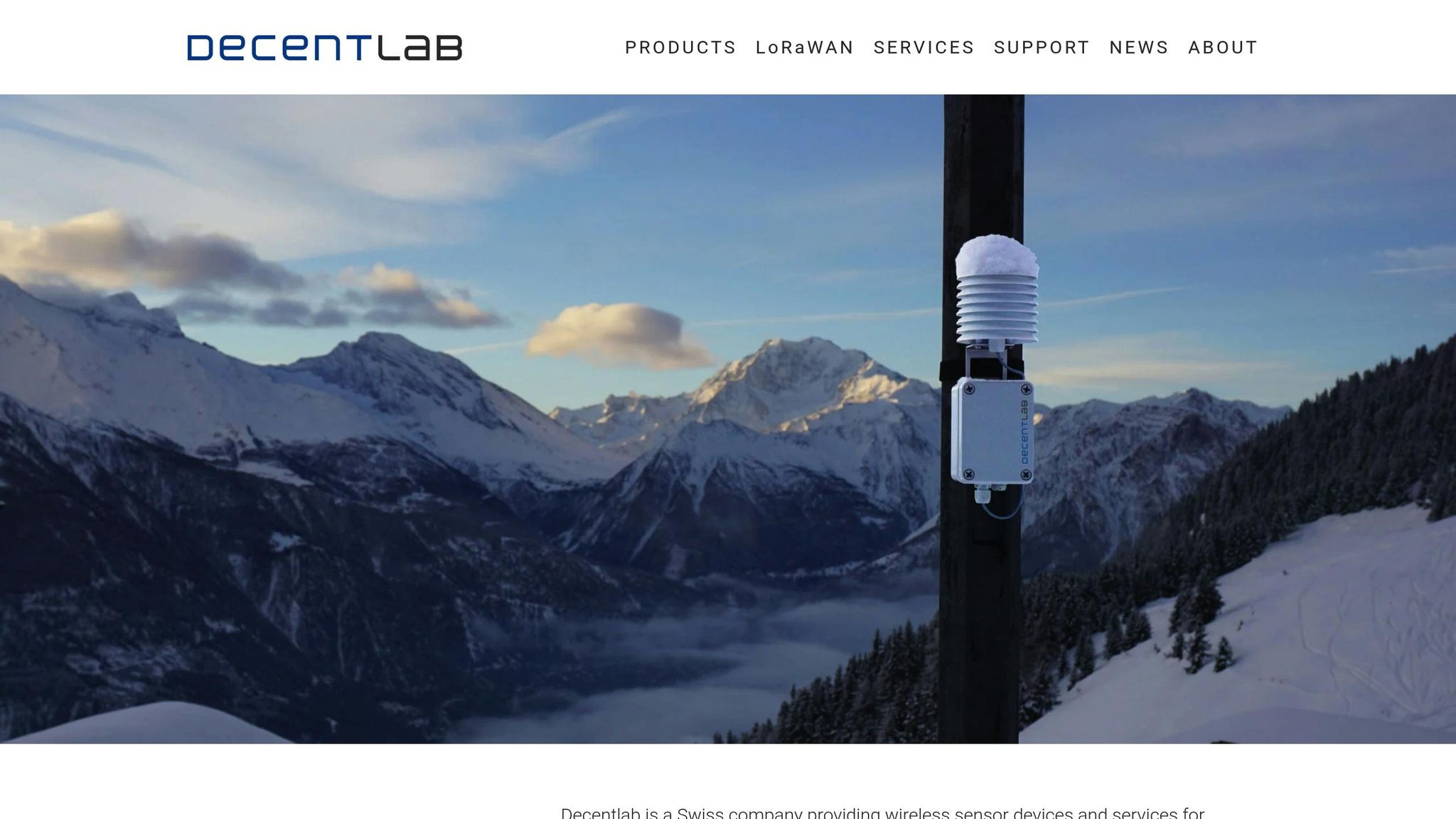
The Decentlab DL-LP8P CO2 Sensor offers a comprehensive solution for monitoring CO₂ levels in industrial and commercial settings. Made in Switzerland, this device doesn’t stop at CO₂ – it also measures temperature, humidity, and barometric pressure, all packed into a single unit. At $795.00, it’s designed to deliver reliable performance for critical applications.
Measurement Accuracy
With a CO₂ measurement range stretching from 0 to 10,000 ppm, the DL-LP8P ensures precise readings, boasting an accuracy of ±50 ppm or ±3% of the measured value. It employs trusted NDIR technology, which holds up well even in demanding environments. This broad measurement range makes it suitable for tasks like monitoring storage conditions, assessing indoor and outdoor air quality, building automation, energy efficiency projects, and even smart agriculture. Its robust design ensures dependable performance over time.
Battery Life
The sensor is powered by two replaceable alkaline C batteries (LR14), designed to last for years with minimal maintenance. While the exact battery life depends on factors like data transmission frequency and environmental conditions, the system is built to support long-term, reliable operation in both indoor and outdoor environments.
Reporting Interval
The device allows you to adjust the transmission intervals, letting you strike the right balance between detailed data collection and conserving battery life.
Integration and Compatibility
The DL-LP8P operates on LoRaWAN Class A, making it easy to integrate with standard LoRaWAN networks. To get started, simply register the device’s unique Device ID and EUI with a LoRaWAN Network Server. An essential step in the setup is using Decentlab’s payload decoder, which converts raw sensor data into a structured JSON format. This makes it compatible with a variety of data visualization tools, enabling seamless analysis.
Additional Features
Beyond CO₂ monitoring, this sensor provides a full environmental snapshot by measuring temperature, humidity, and barometric pressure simultaneously. Housed in a weatherproof polycarbonate casing, it’s built to handle both indoor and outdoor conditions, making it a versatile choice for everything from storage facilities to agricultural applications.
Advantages and Disadvantages
Taken together, CO₂ sensors come with a mix of strengths and weaknesses, balancing factors like cost, battery life, accuracy, durability, ease of setup, and features. The table below provides a snapshot of each sensor’s key benefits, drawbacks, and ideal use cases.
| Sensor Model | Key Advantages | Main Disadvantages | Best Use Case |
|---|---|---|---|
| QingPing LoRaWAN CO₂ | Affordable, reliable NDIR technology, decent battery life | Limited measurement range (0-5,000 ppm), basic features | Small offices, residential spaces |
| EvolvePlus Indoor Air Quality | Tracks multiple parameters, sleek design, detailed data | Higher power usage, suitable for indoor use only | High-end smart buildings, office spaces |
| MClimate CO₂ Sensor & Notifier | Built-in visual alerts, easy-to-use interface, moderately priced | Shorter battery life due to display, limited outdoor functionality | Classrooms, meeting rooms |
| Talkpool OY1210 | Durable, handles extreme temperatures, reliable in tough conditions | Expensive ($450+), setup can be complex | Industrial sites, harsh environments |
| CHOOVIO LoRaWAN Solutions | Easy integration, simple plug-and-play setup, strong support | Limited customization, availability can vary | Quick deployments, standard applications |
| Senseair Sunrise | Highly accurate (±30 ppm), compact, energy-efficient | Expensive, needs technical expertise to operate | Labs, precision-focused environments |
| Elsys ERS | Handles multiple parameters, sturdy housing, flexible configurations | Data can be complex to interpret, steeper learning curve | Research settings, environmental studies |
| Decentlab DL-LP8P | Swiss-made precision, weatherproof, detailed environmental data | Very expensive ($795), overkill for basic needs | Outdoor monitoring, critical infrastructure projects |
Prices range widely, from under $200 to nearly $800, reflecting differences in features, accuracy, and build quality.
Battery life is another key factor. Sensors with displays, like the MClimate model, may need battery replacements every 12–18 months. On the other hand, industrial-grade options like Decentlab and Talkpool are designed for extended battery life.
Indoor vs. outdoor use is also a deciding factor. While most sensors are optimized for indoor environments, models like the Decentlab DL-LP8P are weatherproof and built for outdoor conditions. Temperature tolerance varies, with industrial-grade sensors performing well in extreme climates, unlike consumer-grade alternatives.
Setup complexity ranges from straightforward plug-and-play options, like CHOOVIO, to more technical models requiring custom configurations and payload decoders.
Lastly, multi-parameter sensors provide a wealth of data for those needing detailed insights but can be harder to interpret. Simpler, single-purpose sensors are better suited for straightforward monitoring tasks.
Conclusion
In summary, after evaluating the top CO₂ sensors on the market, here are the key insights to help you make an informed choice:
The best sensor for you will depend on your specific goals, budget, and technical needs. For those working within a tight budget, the QingPing LoRaWAN CO₂ sensor is a great fit for small offices and residential setups.
If speed and simplicity are your priorities, CHOOVIO’s LoRaWAN solutions offer a hassle-free, plug-and-play setup with reliable technical support – perfect for organizations that need quick deployment.
For industrial environments, where durability is non-negotiable, the Talkpool OY1210 stands out as a rugged option designed to handle tough conditions.
When precision is paramount, the Senseair Sunrise is the go-to choice. Its high accuracy makes it ideal for research labs, clean rooms, and other settings where even small deviations in measurements matter.
If you’re managing smart building systems and need to monitor multiple parameters, the EvolvePlus Indoor Air Quality series or Elsys ERS sensors are tailored for multi-parameter tracking.
To get the most out of your investment, choose sensors that align closely with your accuracy, range, and integration requirements. Also, ensure they can seamlessly work with your existing LoRaWAN infrastructure for a smooth and efficient implementation.
FAQs
What should I consider when selecting a CO2 sensor for my IoT application?
In short, when selecting a CO2 sensor for your IoT application, it’s crucial to tailor your choice to the specific demands of your environment and system. Start by evaluating the sensor’s measurement range to ensure it matches the typical CO2 levels you’ll be monitoring. Also, consider its accuracy and how well it can withstand the conditions of your environment.
For indoor applications like smart buildings, you might want to look for sensors that offer additional capabilities such as temperature and humidity monitoring. Compatibility with your IoT setup is another essential factor – check if the sensor works with protocols like LoRaWAN, and review its connectivity options and power requirements to ensure it fits seamlessly into your infrastructure, whether it’s a fixed or portable system.
By focusing on these aspects, you’ll be better equipped to choose a sensor that delivers reliable performance and aligns perfectly with your application’s needs.
What should I consider when adding a CO2 sensor to my IoT system?
When incorporating a CO2 sensor into your IoT system, it’s important to prioritize placement and coverage to get accurate and consistent readings. Position the sensor where it can capture typical air circulation patterns, steering clear of spots with unusual airflow or physical obstructions that could skew the data.
Make sure the sensor is compatible with your current IoT setup, including smooth integration with platforms like data management systems, building automation tools, or HVAC systems. Opt for sensors that support connectivity protocols like LoRaWAN to ensure efficient data transmission and reliable communication.
Finally, evaluate the sensor’s data processing features and its adherence to environmental regulations. Choosing a sensor that meets your operational requirements and aligns with ethical standards will help maintain performance and reliability over time.
Why is battery life important for CO2 sensors in smart building systems?
Battery life is a key factor in how well CO2 sensors perform and how easy they are to maintain in smart buildings. Sensors equipped with batteries that last 5 to 10 years significantly cut down on the need for frequent replacements. This not only reduces maintenance costs but also helps avoid interruptions to building operations.
A longer battery lifespan ensures uninterrupted and dependable monitoring of indoor air quality and energy usage, which is especially important in large buildings or areas that are tough to access. In contrast, sensors with shorter battery lives demand more frequent servicing, increasing maintenance workload and potentially leading to downtime. This could impact the accuracy of environmental data and the overall performance of the system.

