

LoRaWAN vs. Traditional Systems: Cost Comparison
When deciding between LoRaWAN and cellular-based IoT systems (like LTE-M or NB-IoT), the choice often boils down to long-term costs. Here’s the bottom line: LoRaWAN is generally more cost-effective for large-scale IoT deployments due to its lower installation, hardware, and ongoing expenses. Cellular systems, while easier to set up in some cases, come with higher recurring costs and scaling challenges.
Key Takeaways:
- LoRaWAN:
- Lower upfront costs: Gateways cost ~$1,100; sensors $8–$10 each.
- No monthly device fees: Operates on free, unlicensed spectrum.
- Long battery life: Sensors last 10–15 years, reducing maintenance costs.
- Scales efficiently: One gateway covers miles and supports thousands of devices.
- Cellular Systems:
- Higher initial costs: Sensors cost $50–$75 each; site installations average $6,400.
- Monthly fees: $1–$10 per device, adding up quickly for large deployments.
- Frequent maintenance: Higher power usage means more battery replacements.
- Linear scaling: Costs increase directly with the number of devices.
Quick Comparison:
| Category | LoRaWAN (Private) | Cellular IoT (LTE-M/NB-IoT) |
|---|---|---|
| Sensor Cost | $8–$10 | $50–$75 |
| Gateway Cost | ~$1,100 | Included in service |
| Installation Cost | ~$2,100 per site | $3,200–$10,700 per site |
| Connectivity Fees | $0 | $1–$10/device/month |
| Battery Life | 10–15 years | 2–5 years |
| 5-Year TCO (100 Devices) | ~$5,300–$6,000 | ~$12,000–$15,500 |
For deployments over 10,000 devices, LoRaWAN can save hundreds of thousands to millions of dollars annually. If you’re scaling IoT networks or managing remote sensors, LoRaWAN’s cost advantages make it a strong choice.
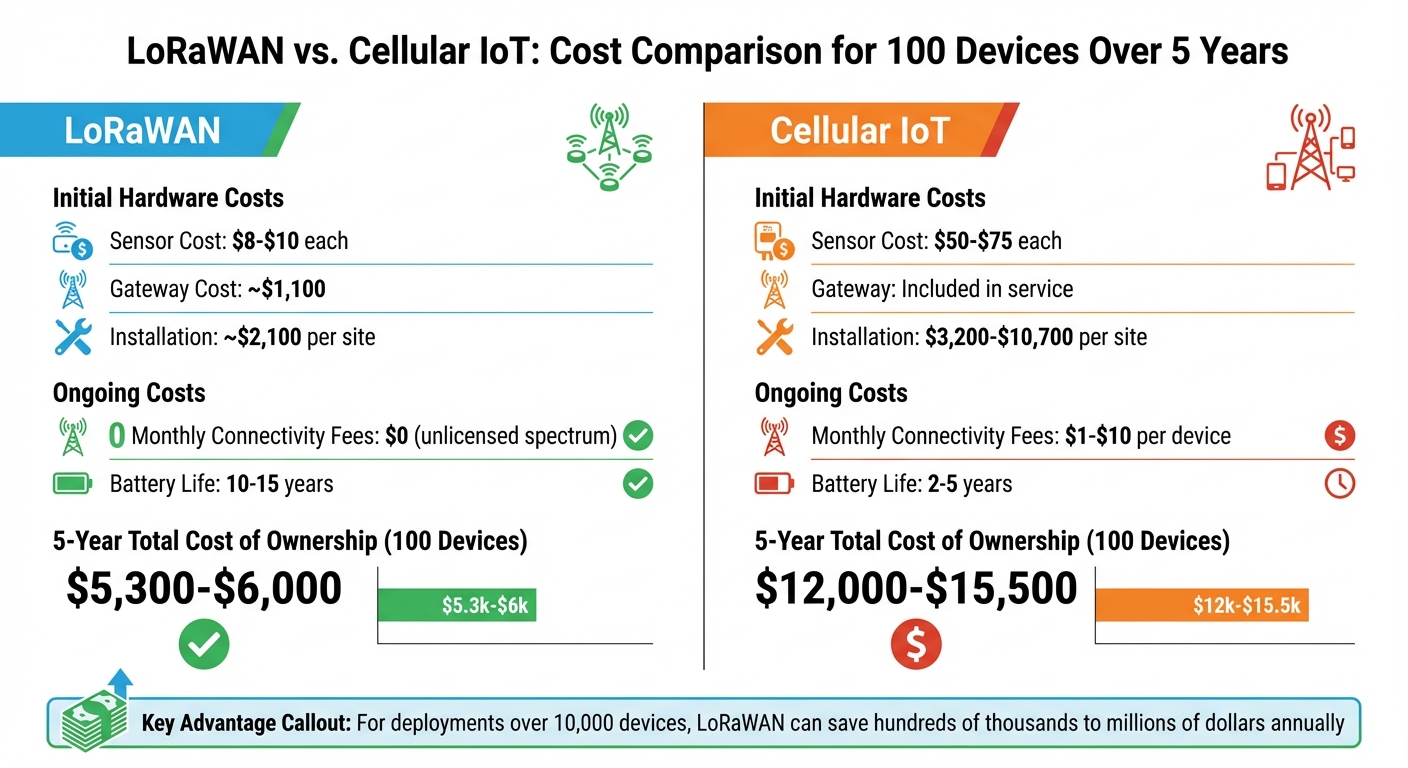
LoRaWAN vs Cellular IoT Systems: 5-Year Cost Comparison
Cost Structure of Traditional IoT Systems
Capital Expenditure (CapEx) in Traditional Systems
Setting up traditional IoT systems demands a hefty upfront investment. The hardware – such as cellular modems, industrial sensors, and controllers – is just the tip of the iceberg. For cellular-based systems like NB-IoT or LTE-M, equipment costs typically fall between $3,200 and $10,700 per site, with LTE-M installations averaging around $6,400.
But the real costs pile up with site preparation and installation. Labor and setup expenses alone can reach about $10,700 per site, while a complete site build – factoring in rooftop access, mounting structures, and permits – can soar to $21,400 in urban areas.
“Think of a LoRaWAN® network like building a house. The bricks don’t cost much; it’s the labor, permits, and upkeep that add up.”
Greenfield deployments face even steeper costs due to the need for new site acquisitions and infrastructure adjustments. Interestingly, the cellular modules themselves typically account for less than 5% of the total system cost.
And remember, the initial investment is just the beginning. Ongoing operational expenses add to the financial burden.
Operational Expenditure (OpEx) in Traditional Systems
After installation, traditional IoT systems come with recurring costs that can’t be ignored. Connectivity fees for cellular IoT devices usually range from $2 to $10 per month per device. For example, a deployment of 10,000 sensors at $2 per month results in $240,000 annually just for connectivity.
Maintenance is another unavoidable expense. A single technician visit – or “truck roll” – can cost 5 to 10 times the price of the gateway hardware. Annually, maintenance typically adds about 10% of the initial CapEx. For a $50,000 installation, that’s an extra $5,000 every year.
Other recurring costs include site leasing, which can range from $3,700 to $8,500 per year, electricity at around $1,100 annually, and backhaul connectivity. In remote locations, satellite backhaul costs can be two to eight times higher than standard urban internet services. Some satellite providers even cap usage to as few as 750 messages per month.
Challenges of Scaling Traditional Systems
Scaling traditional IoT systems compounds these financial challenges. Adding more sensors often requires revisiting and modifying existing sites, driving costs even higher.
What’s more, the cost structure grows linearly as you add devices. For example, a utility company deploying 20,000 meters would need to keep monthly connectivity costs below $0.30 per meter to remain financially viable. Anything above this threshold makes scaling traditional systems an economic roadblock.
Cost Structure of LoRaWAN-Based IoT Systems
Capital Expenditure (CapEx) in LoRaWAN Systems
LoRaWAN systems offer a cost-effective alternative to traditional cellular setups, significantly lowering upfront expenses. For instance, the average equipment cost per site is about $1,100, a stark contrast to the $3,200 to $10,700 range typical for cellular systems. LoRaWAN modules are also budget-friendly, priced at approximately $8–$10 each, partly due to their straightforward antenna designs and the absence of SIM cards. Building a LoRaWAN site typically costs around $2,100, whereas cellular-grade installations in urban areas can soar to $21,400.
The infrastructure requirements for LoRaWAN are minimal, further trimming setup costs. Instead of the extensive site preparation cellular systems demand, LoRaWAN relies on basic mounting hardware, cabling, and lightning protection. Plus, spectrum costs are zero since LoRaWAN operates on unlicensed ISM bands (915 MHz in North America), eliminating the need for spectrum licensing fees. Over a five-year period, gateways account for less than 3% of total network costs, and their lifespan of 15–20 years reduces the need for frequent replacements.
“The smarter question isn’t ‘How much does this gateway cost?’ but ‘How much will this network cost to run for the next five years?'”
These lower initial costs lay the groundwork for reduced operational expenses, making LoRaWAN a financially sustainable choice.
Operational Expenditure (OpEx) in LoRaWAN Systems
LoRaWAN systems don’t just save on upfront costs – they also minimize ongoing expenses. By operating on unlicensed bands, they avoid spectrum licensing and per-device fees. With no recurring connectivity charges, operational costs are primarily limited to gateway backhaul and occasional maintenance. In contrast, cellular systems can charge $2 to $10 per device per month.
Battery longevity is another game-changer. LoRaWAN sensors typically last 10 to 15 years on a single battery, drastically reducing the frequency and cost of replacements. Remote management features, like firmware updates and diagnostics, eliminate the need for costly technician visits – avoiding “truck rolls” that can cost 5 to 10 times the price of gateway hardware.
Carrier-grade gateways also enhance efficiency by reducing the number of units required by 30% to 50%, which directly lowers annual maintenance costs. For remote deployments, smart data filtering at the gateway level can cut backhaul traffic by 12% to 34%, further reducing connectivity expenses.
Scaling Advantages of LoRaWAN
The cost benefits of LoRaWAN become even more pronounced as networks scale. A single gateway can cover up to 6 miles in rural areas and several miles in urban settings, supporting hundreds or even thousands of sensors, depending on their reporting frequency.
For utility companies managing over 20,000 meters, private LoRaWAN networks often prove more economical than cellular options, especially when cellular costs exceed $0.30 per meter per month. Networks with 10,000 to 100,000 devices can see savings ranging from hundreds of thousands to millions of dollars annually.
“Total deployment and operating network costs fall by 30-50% minimum, leading to annual savings of millions [when using carrier-grade gateways].” – Roman Nemish, President, TEKTELIC
Carrier-grade gateways, known for their superior coverage and lower packet drop rates, can slash total deployment and operating costs by at least 30% to 50%. This scalability reduces per-device costs and supports efficient, cost-effective network growth.
Direct Cost Comparison: LoRaWAN vs. Traditional Systems
Hardware and Installation Costs
When it comes to upfront costs, LoRaWAN stands out as a more affordable option. LoRaWAN modules are priced between $8 and $10 each, while cellular IoT modules (such as LTE-M or NB-IoT) cost significantly more, ranging from $50 to $75 per unit. For a deployment of 100 sensors, this translates to hardware savings of approximately $4,000 to $6,500.
Installation costs also favor LoRaWAN. Setting up a private LoRaWAN network typically involves an investment of about $2,000, which includes basic mounting hardware, cabling, and lightning protection. Additionally, deploying gateways costs around $1,000 per unit. On the other hand, traditional cellular systems often rely on existing carrier towers, with installation fees ranging between $500 and $1,000. However, these lower installation fees come with much higher recurring connectivity costs. Another major cost advantage for LoRaWAN is its use of unlicensed 915 MHz spectrum, which eliminates licensing fees. In contrast, cellular systems operate on licensed spectrum, with those costs baked into service plans. Annual site leasing for LoRaWAN is typically between $400 and $1,000, while cellular infrastructure costs can reach $3,500 to $8,000 per year. These differences in hardware and installation costs create a strong foundation for LoRaWAN’s long-term affordability.
Connectivity and Maintenance Costs
Once the initial setup is complete, operational costs further highlight LoRaWAN’s affordability. Traditional cellular systems charge $1 to $10 per device per month for connectivity, which adds up to $1,200 to $12,000 annually for a 100-device deployment. In contrast, LoRaWAN’s use of unlicensed spectrum means there are no per-device connectivity fees. Recurring costs are instead limited to gateway backhaul and network management, which typically range from $200 to $500 per gateway per month.
Battery life is another area where LoRaWAN shines. Its devices can operate for 10 to 15 years on a single battery, while cellular devices – known for their high power consumption – require frequent battery replacements. Each site visit for battery replacement or maintenance, often called a “truck roll”, can cost five to ten times the price of a gateway. LoRaWAN’s ability to support remote firmware updates and diagnostics minimizes these costly field visits, further reducing operational expenses.
5-Year Total Cost of Ownership (TCO)
Over a five-year period, the cost differences become even more apparent. For a typical deployment of 100 sensors, LoRaWAN’s total cost of ownership (TCO) is estimated at $5,300 to $6,000. In comparison, traditional cellular systems cost between $12,000 and $15,500 over the same timeframe.
| Cost Component | LoRaWAN (Private) | Traditional Cellular (LTE-M) |
|---|---|---|
| Hardware (100 Sensors) | $800 – $1,000 | $5,000 – $7,500 |
| Gateway Costs | $1,000 | Included in service |
| Installation & Setup | $2,000 | $500 – $1,000 |
| Connectivity Fees (5 Years) | $0 (Unlicensed) | ~$6,000 (at ~$1/mo per device) |
| Maintenance & Operations | $1,500 – $2,000 | $500 – $1,000 |
| Total 5-Year TCO | ~$5,300 – $6,000 | ~$12,000 – $15,500 |
The cost savings grow exponentially for larger deployments. For projects involving tens of thousands or even hundreds of thousands of devices, LoRaWAN can save hundreds of thousands to millions of dollars annually. Industry analysis suggests that while cellular systems may be more economical for very low-density deployments, LoRaWAN’s cost advantages become increasingly clear as the number of devices scales up. This stark contrast in TCO makes LoRaWAN a compelling choice for large-scale IoT implementations.
sbb-itb-0e600ab
Cost-Effective Integration Strategies with LoRaWAN
Hybrid Integration with Legacy Systems
You don’t need to overhaul your entire infrastructure to take advantage of LoRaWAN. By using protocol bridges like RS485/Modbus-to-LoRaWAN converters, your existing meters, I/O modules, and controllers can be connected wirelessly. This setup supports communication over distances of up to 12 miles in rural areas and 3 miles in urban environments, all while utilizing the existing 24V DC power supply.
For applications requiring real-time control, Class C LoRaWAN devices offer a practical solution. These devices stay continuously active for reception, enabling seamless two-way communication with actuators such as valves or motors. This helps minimize latency in critical control operations.
“Integrating legacy systems is an engineering challenge rather than a simple plug-and-play fix.” – Lawrence Griffiths, IoT Specialist
Incremental Deployment for Cost Efficiency
Phased deployment can make integrating LoRaWAN even more budget-friendly. Start small and expand strategically. For instance, deploy LoRaWAN at monitoring points that currently rely on expensive manual readings or frequent maintenance visits. Focus on locations where technician costs are high to maximize return on investment. Using RF mapping tools to determine optimal gateway placement can further cut unnecessary expenses.
As your network grows to include over 10,000 devices, the cost benefits of LoRaWAN become even more evident. Carrier-grade gateways can reduce the number of units needed by 30% to 50%, and gateways typically account for less than 5% of the five-year total cost of ownership. Investing in high-quality hardware upfront also pays off by reducing labor costs during installation and minimizing ongoing maintenance needs. These scalable strategies pave the way for adopting premium solutions as your network matures.
Using CHOOVIO‘s LoRaWAN Solutions
CHOOVIO provides a wide selection of LoRaWAN sensors, gateways, and controllers tailored for North American frequency bands (915 MHz). With same-day processing and shipping from Irvine, California, CHOOVIO helps minimize downtime during phased rollouts. Their offerings include soil moisture sensors priced at $122, valve controllers ranging from $169 to $269, and complete weather stations available for $3,300. To make scaling IoT networks more affordable, CHOOVIO also offers complimentary shipping on larger orders, making it a reliable one-stop shop for businesses expanding their LoRaWAN deployments.
(480) How does NB-IOT and CAT-M1 / LTE-M compare to LoRaWAN (Tutorial)?
Conclusion
Our cost analysis highlights a clear winner: LoRaWAN outshines traditional systems when it comes to cost-efficiency. Over a five-year period, LoRaWAN delivers significant savings for IoT deployments in the U.S. Gateway hardware represents less than 5% of total costs, while the bulk stems from installation, maintenance, and backhaul expenses. For deployments ranging from 10,000 to 100,000 devices, the savings can climb into the hundreds of thousands – or even millions – each year, particularly when compared to cellular solutions that average about $12 per device annually.
The scalability of LoRaWAN is especially appealing in North American markets, where high labor and leasing costs make efficient infrastructure a necessity. Carrier-grade gateways can reduce the number of required units by 30% to 50%, cutting both upfront installation costs and ongoing operational expenses. Additionally, remote management capabilities eliminate the need for costly field visits, further driving down operational costs.
“The real expense of a LoRaWAN® network shows up in the field – during installation, maintenance, and operations.” – TEKTELIC
For those looking to transition from traditional systems, hybrid integration offers a flexible and phased approach. This allows organizations to integrate with existing infrastructure while staying aligned with budgetary priorities.
CHOOVIO simplifies this process with pre-configured LoRaWAN sensors, gateways, and controllers tailored for North American frequencies. These solutions make it easier to tap into the cost-saving potential of LoRaWAN across a variety of IoT applications, including agriculture, industrial operations, and smart cities.
FAQs
Why is LoRaWAN more cost-effective than cellular systems for IoT networks?
LoRaWAN stands out as a cost-effective solution by utilizing unlicensed radio frequencies, which means there’s no need to pay for pricey cellular subscription plans. On top of that, its ultra-low-power devices are built to transmit small, infrequent data packets. This design not only cuts down on energy use but also keeps network infrastructure expenses in check.
Because of these advantages, LoRaWAN is a great fit for IoT applications where keeping costs low and ensuring long-term savings are top priorities. Industries like agriculture, smart cities, and manufacturing are already benefiting from its affordability and efficiency.
What makes LoRaWAN more scalable than traditional IoT systems?
LoRaWAN owes its scalability to a smart design and an efficient architecture that keeps costs low. Using a star-of-stars topology, it enables low-power gateways to gather data from thousands of devices spread out over several miles. This setup reduces the need for heavy infrastructure, keeping things simple and effective. Plus, by operating in unlicensed sub-GHz ISM bands – like the 902–928 MHz range used in the U.S. – it avoids the high costs associated with spectrum licenses. Expanding the network is straightforward too; just add more nodes or gateways as needed.
A couple of standout features make LoRaWAN even more efficient. Adaptive Data Rate (ADR) and chirp-spread-spectrum modulation work together to fine-tune device performance. They adjust transmission power and data rates dynamically, cutting down on interference and freeing up network capacity. On top of that, LoRaWAN devices are incredibly energy-efficient. Many can run for up to 10 years on a single battery, which not only lowers maintenance costs but also makes large-scale deployments much easier to manage.
Thanks to its low hardware costs and ability to scale without driving up operational expenses, LoRaWAN stands out as a perfect fit for massive IoT deployments. It’s a practical alternative to more traditional wired or cellular systems.
How does LoRaWAN compare to traditional systems for integrating IoT into existing infrastructures?
LoRaWAN is built to fit seamlessly into existing IoT setups, providing a cost-efficient and practical alternative to more traditional systems. Thanks to its star-of-stars architecture, gateways serve as intermediaries, bridging IoT devices and network servers to ensure dependable communication over vast areas.
This technology enables the creation of IoT networks that are scalable, energy-conscious, and suitable for a variety of applications – from smart city solutions to agricultural innovations. With CHOOVIO’s range of LoRaWAN sensors and gateways, building and expanding customized IoT networks becomes straightforward and hassle-free.

