

Why LoRaWAN Sensors Show Incorrect Data
LoRaWAN sensors often provide inaccurate data due to issues like poor calibration, hardware degradation, RF signal challenges, and network congestion. These problems can lead to unreliable readings in critical applications like healthcare, agriculture, and infrastructure monitoring. Key causes include:
- Calibration Issues: Sensors drift over time or are improperly installed.
- Hardware Problems: Antenna wear, weather damage, or power instability degrade performance.
- Signal Interference: Obstacles, weather, and overlapping frequencies disrupt communication.
- Network Congestion: Packet collisions and duty cycle limits reduce data transmission reliability.
To improve accuracy:
- Regularly maintain and monitor sensors.
- Use high-quality hardware with proper placement.
- Optimize network settings like spreading factors and data rates.
- Add more gateways to reduce signal loss.
Reliable performance requires attention to setup, monitoring, and addressing interference or congestion. These steps ensure consistent and accurate data for IoT networks.
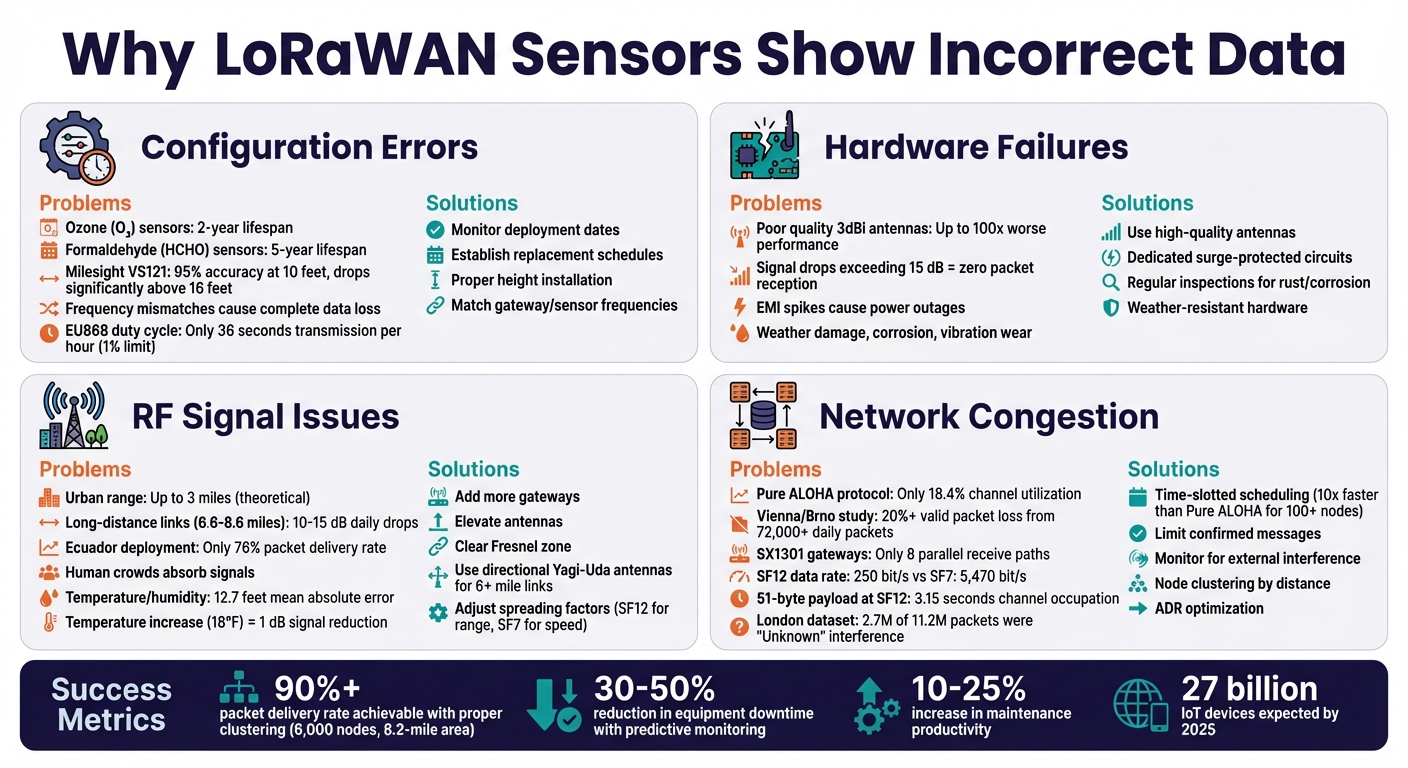
Common Causes of LoRaWAN Sensor Data Inaccuracy and Solutions
How to avoid LoRaWAN® network troubleshooting
Configuration Errors That Cause Incorrect Data
Even the most advanced LoRaWAN sensors can produce inaccurate data if not configured correctly. Many of these issues arise during the initial setup, but catching them early can save you from costly misreadings and system interruptions.
Sensor Calibration Problems
Calibration is a critical step that often gets overlooked. Take ozone (O₃) sensors, for example – they generally last around 2 years, while formaldehyde (HCHO) sensors can function effectively for up to 5 years. Beyond these timeframes, their readings become unreliable. To avoid this, it’s important to monitor deployment dates and establish a replacement schedule before the sensors reach the end of their functional lifespan.
Placement also has a big impact on calibration accuracy. For instance, the Milesight VS121 people counter boasts a 95% recognition rate when installed at a height of 10 feet (3 m). However, its performance drops significantly if mounted higher than 16 feet (5 m). Similarly, ultrasonic sensors in the UDL series face challenges detecting moving vehicles due to the Doppler effect, which calibration alone cannot fix.
Gateway and Device Setup Errors
Errors in gateway and device setup can also lead to inaccurate data collection. One common issue is frequency mismatches. For example, in the US915 band, if a gateway isn’t configured to monitor the same channels as the sensors, data packets are lost, making it seem like the sensor isn’t working at all.
Another problem is setting the wrong initial data rate, which delays Adaptive Data Rate (ADR) convergence. This leads to prolonged packet loss and inefficient communication. On the EU868 band, the 1% duty cycle restricts transmissions to just 36 seconds per hour, significantly limiting data throughput.
Additionally, misaligned Class-B beacons can interfere with scheduled downlink slots, and using default encryption keys leaves the network vulnerable to security breaches.
Hardware Failures and Connection Problems
When LoRaWAN data starts acting up, physical hardware problems are often the unspoken culprits. Unlike configuration glitches that can be fixed remotely, these issues usually demand on-site troubleshooting and, in many cases, hardware replacement.
Faulty or Aging Hardware
One of the most common problems? Antenna degradation. Many so-called professional 3dBi gain antennas fail to deliver on their promises, offering signal performance that’s up to 100 times worse than higher-quality alternatives. Add to that physical wear and tear – like weather damage, loose connections caused by constant vibration, or corroded connectors – and your signal integrity can plummet.
Moisture, industrial chemicals, and relentless vibrations only make things worse, speeding up hardware wear and reducing signal quality over time. For instance, machinery vibrations can weaken solder joints, while temperature fluctuations can create a “hysteresis” effect, where signal accuracy fluctuates during warm-up or cool-down cycles.
These kinds of hardware issues don’t just affect signal quality – they can wreak havoc on your network’s overall performance, leading to power instability and connectivity problems.
Power and Connectivity Issues
Power instability is another headache that can throw off your data. In one case, a gateway sharing its power circuit with an automated pump experienced repeated outages due to electromagnetic interference (EMI) spikes and voltage drops. The solution? A dedicated, surge-protected circuit.
Connectivity problems can also drain resources. Devices struggling with poor signal often need to retransmit data, which not only consumes more battery power but also results in erratic performance – even with brand-new batteries. Long-distance disruptions can be even more severe, with signal drops exceeding 15 dB completely wiping out data transmission, reducing packet reception ratios to zero.
To combat these issues, regular inspections are crucial. Look for signs of rust, corrosion, or water ingress, especially in outdoor setups or humid environments. These small steps can go a long way in maintaining reliable performance.
RF Signal and Coverage Issues
Even with the best hardware, RF signal challenges can throw a wrench into LoRaWAN deployments. The world of RF signals is, quite literally, invisible – and that’s often where problems begin.
Weak Signals and Range Limits
Distance is a major hurdle for reliable LoRaWAN communication. While the technology is capable of reaching up to 3 miles in urban environments with just 25 mW of power, real-world conditions rarely align with these theoretical limits. The farther signals travel – or the more obstacles they encounter – the weaker they become. And weak signals? They often translate to unreliable or lost data.
Take the findings from Ghent University–IMEC, for example. Between May and July 2018, researchers deployed six custom LoRa nodes across Ghent, Belgium, to study long-distance link performance. They observed that links stretching 6.6 miles and 8.6 miles experienced daily signal drops of 10–15 dB, often reducing packet reception rates to zero. Urban environments and seasonal weather changes were identified as the main culprits. To address these issues, increasing the number of gateways and fine-tuning spreading factors are critical steps.
Adding more gateways shortens the distance between sensors and the network, improving signal reliability. Adjusting spreading factors can also help. Higher spreading factors, like SF12, increase sensitivity and extend range, but they come at the cost of slower data rates.
Environmental Interference
Distance isn’t the only factor messing with RF signals. Environmental conditions can be equally disruptive. Temperature changes, humidity, physical barriers, and even crowds of people can interfere with RF signals, directly affecting data quality.
A 2022 deployment in Chirinche Bajo, Salcedo, Ecuador, highlighted this issue. Led by Renato Mauricio Toasa Guachi, the project monitored crops at altitudes above 9,547 feet. The network faced significant interference from 15% terrain slopes and dense eucalyptus trees, which resulted in a packet delivery rate of just 76% for uplinks – even with a spreading factor of 9.
Buildings, thick stone walls, and vegetation are notorious for blocking and absorbing RF signals. Even human bodies can cause disruptions. In May 2018, Ghent University researchers observed a LoRa link located 2.5 miles from a transmitter becoming unstable during working hours. The reason? Crowds at a nearby student restaurant absorbed the signal – a rare but fascinating example of human-induced interference in an outdoor LoRa network.
Weather adds another layer of complexity. Snowfall is particularly harmful over long distances, while rain causes smaller, though still measurable, signal fluctuations. Between 2024 and 2025, a study at XJTLU’s south campus sports field used three LoRa nodes to collect 1,000 ranging measurements per reference point. The researchers found that temperature and humidity changes created “error bands” in RF Time of Flight ranging, leading to a mean absolute error of 12.7 feet (3.88 meters).
To tackle these challenges, elevate your antennas to avoid ground-level obstructions and ensure the first Fresnel zone – the elliptical area between the transmitter and receiver – is clear. For long-distance links exceeding 6 miles, using directional Yagi-Uda antennas at receiver sites can significantly improve your link budget.
sbb-itb-0e600ab
Network Congestion and Interference
Beyond the hardware and RF signal challenges already discussed, network congestion is another critical factor that undermines data accuracy. Even when RF signals are strong and hardware is functioning properly, congestion within the network can significantly disrupt data transmission. LoRaWAN networks rely on a “Pure ALOHA” protocol, where sensors transmit data whenever it becomes available, without any coordination or scheduling. While this approach can work for small-scale deployments, it becomes problematic as networks grow, increasing the likelihood of packet collisions.
Network Congestion Effects
The “Pure ALOHA” protocol is inherently inefficient, achieving only 18.4% channel utilization. This means that over 80% of the network’s capacity is lost due to collisions and interference. Field studies conducted in Vienna and Brno observed more than 72,000 packets transmitted daily, with valid packets dropping by over 20% because of congestion and interference.
Another challenge is receiver saturation. Most commercial LoRaWAN gateways, such as those using the SX1301 chip, are equipped with only 8 parallel receive paths. Once all these paths are occupied, the gateway cannot process additional signals, leading to packet loss.
“Late packets have several implications on the performance and reliability of IoT applications, including… Data Staleness: The performance of applications relying on real-time or near-real-time data may suffer due to late packets.”
– Josh Blau, Technical Support Manager, MachineQ
The situation worsens with confirmed messages, which require acknowledgments. Duty cycle regulations, such as the 1% transmission limit in the EU868 band, restrict how often devices can transmit. When gateways hit this limit and cannot send acknowledgments, sensors interpret the lack of response as a failed transmission and attempt to resend the data. This creates a feedback loop that exacerbates congestion.
In addition to collisions caused by traffic volume, overlapping frequencies introduce another layer of interference.
Frequency Overlap and Device Interference
Frequency overlap presents a significant challenge to data accuracy. LoRaWAN operates in unlicensed ISM bands, such as 868 MHz in Europe and 915 MHz in the United States, which are open to any device. This accessibility allows non-LoRaWAN systems, proprietary devices, and even other LoRaWAN networks to interfere with transmissions. For example, a dataset collected in London revealed that nearly 2.7 million out of 11.2 million packets were classified as “Unknown”, likely originating from non-LoRaWAN systems using the same frequencies.
Interference can also occur within a single LoRaWAN network. Although different Spreading Factors (SF) are designed to minimize interference, packets using the same SF will collide if transmitted simultaneously. This phenomenon can lead to what’s known as the “SF12 Well”:
“When this problem arises [SF12 Well], all the devices performing reliable frame transmission end up using SF12… network performance may degrade steadily into congestion collapse.”
– Lluís Casals et al.
Missed acknowledgments often cause devices to switch to SF12, which operates at a much slower data rate. At SF12, data is transmitted at only 250 bit/s, compared to 5,470 bit/s at SF7. For example, sending a 51-byte payload using SF12 occupies the channel for about 3.15 seconds, blocking other devices from transmitting during that time. As more devices switch to SF12, congestion worsens, creating a downward spiral.
To mitigate these challenges, time-slotted scheduling offers a promising solution. Research shows that this approach can enable data collection at least 10 times faster than Pure ALOHA in networks with 100 or more nodes. Limiting the use of confirmed messages is another effective strategy, as duty cycle restrictions can severely limit downlink capacity. Additionally, monitoring for “Unknown” traffic can help identify external sources of interference contributing to packet loss. Addressing these sources of interference is crucial for improving the accuracy of LoRaWAN sensor data.
Research-Based Solutions
Ensuring accurate data from LoRaWAN sensors means focusing on smart deployment, consistent maintenance, and dependable hardware. A 2023 simulation involving 6,000 nodes spread over a 6.2-mile area achieved a packet delivery rate exceeding 90% by using clustering techniques based on node distance and transmission settings.
Sensor Deployment Guidelines
Strategic sensor placement is key. Grouping nodes closer to gateways minimizes collisions, while deploying redundant gateways ensures stable connectivity even under challenging conditions. These steps directly address common issues like interference and data errors.
Adaptive Data Rate (ADR) plays a crucial role in scalable networks, dynamically adjusting data rates and power levels for optimal performance.
Precise configuration is equally important. For example, while higher spreading factors increase range, they also extend the time on air, which can lead to more collisions. In the EU868 band, duty cycle limits restrict devices to transmitting only 1% of the time – roughly 36 seconds per hour. Additionally, transmissions must be spaced apart by at least 99 times the previous packet’s airtime.
Environmental considerations also matter. Indoor installations should account for building materials – wood allows better signal penetration than concrete – while rural deployments need to consider terrain and elevation for optimal gateway placement. High-capacity gateways can support up to 10,000 devices when data is sent less frequently and at lower data rates.
For applications requiring high precision, like monitoring medicine storage or food safety, sensors with NIST-traceable calibration and internal datalogging capabilities are essential. These features allow sensors to record data during network outages and send it later, ensuring no critical readings are lost.
Maintenance and Monitoring Practices
Regular maintenance and monitoring are essential to prevent data inaccuracies. Over time, sensors can drift out of calibration due to environmental factors like temperature changes or humidity, which may cause material expansion, corrosion, or electrical issues.
Studies show that nearly 50% of scheduled preventive maintenance is unnecessary, wasting resources. In contrast, predictive monitoring programs can cut equipment downtime by 30–50% and boost maintenance productivity by 10–25%.
Continuous monitoring eliminates gaps left by manual checks. For instance, in September 2024, sensors at a Mercedes-Benz plant detected abnormal fan vibrations well before manual inspections could, preventing a potential production stoppage. Similarly, a kerosene tank farm near Raunheim serving Frankfurt Airport saved significant costs by switching to condition-based monitoring. Instead of overhauling massive pumps on a fixed schedule (costing $110,000–$165,000 each), operators used LoRaWAN sensors to extend replacement cycles for functional pumps and identify early wear in others, avoiding expensive emergency repairs.
Monitoring network signal quality is equally important. Metrics like RSSI (Received Signal Strength Indicator) and SNR (Signal-to-Noise Ratio) can reveal weak links in the network, guiding adjustments to sensor or gateway placement. Temperature also impacts signal strength – every 18°F increase in ambient temperature can reduce the received signal level by about 1 dB.
Cross-checking data streams with AI can help confirm anomalies. For example, comparing data from vibration sensors and strain gauges can distinguish genuine issues from sensor malfunctions. Using industrial-grade hardware compliant with ISO 17025 calibration standards further ensures long-term accuracy and limits drift.
Using CHOOVIO Solutions
CHOOVIO offers a range of sensors designed to address accuracy challenges. For instance, the Dragino LHT65N/S-NIS provides NIST certification and high precision, featuring an external NIST-traceable probe with an accuracy tolerance of ±0.54°F. Its built-in temperature sensor maintains a long-term drift of less than 0.036°F per year.
To safeguard data during network outages, many CHOOVIO sensors include built-in datalogging, ensuring no readings are lost.
Technicians can also adjust sensor settings remotely using LoRaWAN downlink and AT commands, reducing the need for on-site visits. CHOOVIO’s monitoring system provides real-time data visualization on mobile and desktop platforms, with automated alerts via text or email when thresholds are breached, enabling quick responses to issues.
These sensors are built for durability, featuring spread spectrum communication to resist interference, weatherproof designs for harsh environments, and a battery life of up to 10 years on a 2,400 mAh non-rechargeable battery.
| Feature | Benefit for Data Accuracy |
|---|---|
| NIST Certification | Ensures reliable, verified sensor readings and reduces calibration errors |
| Datalogging | Captures data during network outages, preventing data loss |
| Remote Downlink | Allows remote adjustments to sensor settings, minimizing on-site interventions |
| Visual Alerts | Quickly identifies hardware or environmental issues |
| ADR (Adaptive Data Rate) | Maintains signal quality by dynamically adjusting power and data rates for changing conditions |
Conclusion
Key Takeaways
LoRaWAN sensor issues often stem from configuration mistakes, hardware problems, RF interference, and network disruptions. Factors like temperature shifts can weaken signal strength, while weather events such as snowfall or heavy rain can severely disrupt long-distance connections. Missteps in settings, like ADR or duty cycle misconfigurations, can further aggravate collisions and lead to data loss.
Achieving reliable data hinges on thoughtful sensor placement, ongoing monitoring, and durable hardware. Grouping nodes closer to gateways, fine-tuning transmission settings with ADR, and incorporating redundant gateways can help boost packet delivery rates to over 90%, even in crowded networks. Whether monitoring vaccine storage, managing water systems, or overseeing industrial processes, unreliable data simply isn’t an option. The strategies outlined above are essential for building dependable networks, ensuring accuracy, and maintaining operational reliability.
Future of IoT Networks
The IoT landscape is advancing at an incredible pace. With IoT connections expected to surpass 27 billion devices by 2025, the need for dependable sensor networks is becoming more urgent. To meet this demand, IoT systems must adapt intelligently – shifting between technologies when channels are congested and using predictive algorithms to enhance performance.
“Exploiting the use of LoRaWAN when the packet delivery rate is high and using alternative technologies when the channel is congested may be beneficial both in terms of cost and dependability of IoT systems.” – Marc Guerrero, Researcher, Universitat Oberta de Catalunya
LoRaWAN’s adoption as an official ITU-T Y.4480 standard highlights its readiness for global industrial applications. As networks scale to support thousands of devices per gateway, success will depend on meticulous configuration, awareness of environmental factors, and continuous performance monitoring. By combining these efforts with strategies like node clustering, ADR optimization, and investing in robust hardware, IoT systems can achieve the reliability required for the next generation of connected devices.
FAQs
How can I make sure my LoRaWAN sensors provide accurate data?
To get the most accurate data from your LoRaWAN sensors, it’s essential to follow a structured calibration process. Begin by consulting the manufacturer’s instructions, which often include specific calibration steps or factory-set adjustments. Use a trusted reference device – like a calibrated temperature or humidity meter – to compare readings in the same environment. If you notice discrepancies beyond the sensor’s tolerance (e.g., ±0.5°F for temperature or ±2% RH), make the necessary corrections in the sensor’s settings as recommended.
It’s also important to evaluate the sensor’s communication performance. Check the signal strength and packet error rates to ensure there are no network-related issues affecting data transmission. Keep the sensor’s internal clock synchronized to avoid timestamp errors, and document all calibration activities, including dates, reference values, and any adjustments made. Regular recalibration, especially after firmware updates, is key to maintaining reliable data.
CHOOVIO offers a variety of LoRaWAN sensors along with detailed calibration guides, making it easier to achieve precise and dependable data for applications like smart-city projects or industrial automation.
How can I reduce congestion in my LoRaWAN network?
To keep your LoRaWAN network running smoothly and reduce congestion, here are a few practical steps you can take:
- Enable Adaptive Data Rate (ADR): Use a congestion-aware ADR algorithm to adjust spreading factors and transmit power dynamically. This helps minimize airtime, especially during high-traffic periods.
- Balance Spreading Factors: Distribute spreading factors wisely. Assign lower spreading factors (like SF7-SF10) to devices with strong signals to prevent overloading higher factors such as SF12.
- Schedule Transmissions: Use time-slotted transmission schedules to avoid collisions from multiple devices transmitting data simultaneously.
Regularly monitoring your network’s traffic is also key. It helps you pinpoint congestion areas and fine-tune parameters like duty cycles and payload sizes for better efficiency. Pairing this approach with hardware from CHOOVIO can enhance integration and optimize performance for your IoT setup.
What causes LoRaWAN sensors to report inaccurate data, and how can it be prevented?
Environmental conditions can have a noticeable impact on the performance of LoRaWAN sensors. Factors like rain, fog, high humidity, and temperature swings can disrupt signal transmission. This interference can weaken signals, degrade the signal-to-noise ratio, and lead to more frequent packet loss. For instance, heavy storms or rising water levels in tidal zones can interrupt communication, causing delays or gaps in data collection.
To tackle these issues, CHOOVIO provides LoRaWAN sensors equipped with built-in calibration and adaptive data-rate capabilities, helping to mitigate the effects of environmental interference. Additional measures, such as choosing the right antenna height, using enclosures that resist moisture, and keeping firmware up to date, can further improve data accuracy. By applying these strategies, you can maintain reliable sensor performance even in challenging weather conditions across the United States.

